
WE ARE AVAILABLE FOR DECEMBER PROJECTS


My Work as a GEO and AEO Specialist on Legiit: What I Have Learned From Real SEO Projects



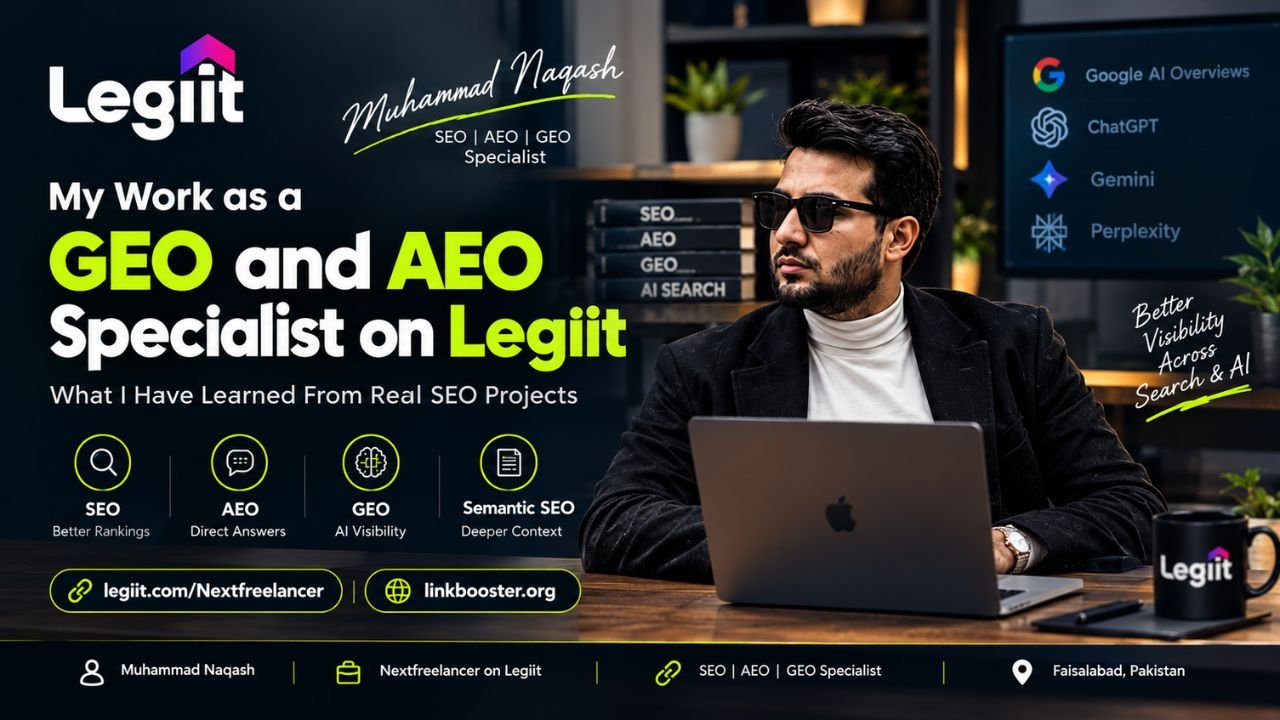
I am Muhammad Naqash, an SEO professional who works on SEO, AEO and GEO strategies and operates on Legiit under the name Nextfreelancer. My approach comes from working on real websites, content campaigns and SEO projects rather than treating GEO as a completely separate replacement for SEO. I focus on making websites and brand information clearer, more useful and easier for search and AI systems to understand.
Who Is Muhammad Naqash?
If you searched for GEO and AEO Specialist on Legiit, you may have reached this article because you want to understand who I am, what I actually do, and what my experience looks like beyond a service listing.
So instead of giving you a typical freelancer introduction, I want to explain my work in a more practical way.
My name is Muhammad Naqash.
On Legiit, I work under the name Nextfreelancer.
My work started with SEO, including content, on page optimization, off page SEO, link building and website visibility. As search continued to change, I became increasingly interested in AEO and GEO and how businesses can make their information more understandable across modern search experiences.
Today, I work across the combination of SEO, AEO, GEO and semantic SEO.
You can find my professional presence through:
The important thing I want to explain in this article is not simply what services I sell.
I want to explain how I think about search visibility and why my work gradually moved from traditional SEO toward SEO, AEO and GEO together.
How I Started Looking at SEO Differently
When I first started learning SEO, the process seemed much more straightforward.
You researched keywords.
You created content.
You optimized pages.
You built links.
You monitored rankings.
Then you made changes based on what you saw.
That basic SEO foundation is still important.
In fact, Google says that its fundamental SEO best practices remain relevant for AI features such as AI Overviews and AI Mode. Google also states that there are no special technical requirements that guarantee inclusion in these AI features. Google for Developers
That point is important because there is a lot of confusion around GEO.
Some people talk about GEO as if traditional SEO suddenly stopped mattering.
I do not see it that way.
I see GEO as part of a wider search visibility strategy.
A technically weak website does not suddenly become strong because someone adds the words GEO to the content.
A website still needs useful information.
The content still needs to satisfy the user’s question.
The website still needs to be accessible to search engines.
The business still needs a clear identity.
And the information still needs to make sense.
This is one of the biggest lessons I have taken from working with websites.
SEO Is Still the Foundation
Before thinking about AI search, I want to understand the website itself.
Can Google crawl it?
Are the important pages indexed?
Does the website clearly explain its services?
Does each page have a clear purpose?
Does the content match the search intent?
Are internal links helping users discover related information?
Does the website demonstrate real experience?
Are important business details consistent?
These questions are not glamorous.
But they matter.
Google’s current documentation for AI features specifically says that standard SEO best practices remain relevant to AI search experiences. Google for Developers
That is why I do not recommend throwing away traditional SEO and replacing it with a collection of GEO tricks.
I prefer building on the foundation that already exists.
Why I Started Focusing More on AEO
AEO means Answer Engine Optimization.
The easiest way I explain it is this:
Traditional SEO often asks:
How can this page become visible for a search?
AEO also asks:
How can this page provide a clear answer to the question behind that search?
That difference changed the way I approach content.
For example, suppose somebody searches:
What is GEO?
A traditional article might spend several paragraphs introducing the subject.
For an answer focused page, I would rather provide the definition early.
GEO, or Generative Engine Optimization, is the practice of improving a website’s information and content so that it is easier for generative AI and AI powered search systems to understand and potentially use when answering relevant questions.
Then I can explain the subject in depth.
This approach is better for the reader because the person does not have to search through the entire article to find the answer.
It also creates a much clearer information structure.
That is one reason I use direct answer sections in many of the articles I create.
What GEO Means to Me
GEO stands for Generative Engine Optimization.
The term is used for strategies focused on visibility within generative AI and AI powered search experiences.
But I do not think GEO should be reduced to one tactic.
It is not simply:
Add keywords.
Publish an AI article.
Get backlinks.
Wait for ChatGPT to mention you.
Real search systems are more complicated than that.
Google’s own guidance published in 2026 emphasizes useful and unique content while also explaining that established SEO fundamentals remain important for generative AI features in Google Search. Google for Developers
OpenAI’s description of ChatGPT search also shows why web visibility matters in an AI environment. ChatGPT search can provide answers together with links to web sources, allowing users to investigate the information behind an answer. OpenAI
That changes the way I think about content.
If a business wants to be understood in AI search, I do not want to create content that exists only for a keyword.
I want to create information that actually explains the subject.
What I Actually Look At During a GEO Project
When I work on GEO, I normally look at several layers.
1. The Brand
First, I want to understand the brand.
Who is the company?
What does it sell?
Who does it serve?
Where does it operate?
What makes it different?
What products or services does it provide?
What topics should it be associated with?
These questions sound simple, but many websites do not answer them clearly.
A company might have a homepage that says:
We provide innovative solutions for modern businesses.
That sounds professional.
But it does not tell me enough.
What solutions?
For whom?
In which industry?
Which location?
What problem does the company solve?
Clear information is more useful than vague marketing language.
2. The Website Content
Next, I look at the content.
I ask whether the website actually answers the questions customers have.
Suppose a company sells a service called GEO Audit.
The page should not only say:
Professional GEO Audit Services.
It should explain:
What is a GEO audit?
What does the audit check?
What information is reviewed?
What does the customer receive?
What problems can the audit identify?
Who needs a GEO audit?
How long does the process take?
How should the findings be used?
Those supporting questions create topical depth.
This is where semantic SEO becomes important.
3. Semantic Relationships
A page about GEO naturally connects to other concepts.
For example:
GEO
AEO
SEO
AI search
AI Overviews
ChatGPT
Gemini
Perplexity
search intent
entities
semantic content
structured data
brand visibility
content quality
topic authority
citations
These concepts should not be inserted simply because they are keywords.
They should appear where they actually help explain the subject.
That is the difference between writing for a topic and writing around a keyword.
4. Entity Information
Entity understanding is another area I pay attention to.
For my own professional identity, the relationship is straightforward.
Muhammad Naqash
SEO, AEO and GEO specialist
Nextfreelancer
My professional name on Legiit
Legiit
The marketplace where I offer services
LinkBooster
A business platform connected with my SEO, AEO and GEO work
My professional social profile
These relationships should be clear rather than scattered and contradictory.
The same principle applies to a company.
If a business uses three different descriptions across its website and professional profiles, it creates unnecessary confusion.
Consistency does not mean copying exactly the same sentence everywhere.
It means the underlying facts should remain consistent.
My Experience With Content Publishing
Content publishing is another area that became more interesting to me as I moved deeper into AEO and GEO.
I learned that simply publishing more articles does not automatically create authority.
I have seen websites with a large number of articles that still have weak topical coverage.
Why?
Because the articles were created individually.
There was no relationship between them.
One article discussed SEO.
Another discussed social media.
Another discussed an unrelated keyword.
Another targeted a random high volume phrase.
There was no central subject.
Instead of doing that, I prefer topic clusters.
For example, if the main subject is GEO, the content ecosystem could include:
What is GEO?
How does GEO work?
GEO versus SEO
GEO versus AEO
How to improve AI search visibility
How to prepare content for AI search
How to measure AI visibility
GEO audit
GEO checklist
GEO for ecommerce
GEO for local businesses
GEO for service businesses
Each article has its own purpose.
Together, they create a larger knowledge structure.
Why I Do Not Treat AI Content as a Shortcut
AI tools can be useful.
I use AI tools myself for research, ideation, structuring and different parts of content development.
But there is an important difference between using AI to assist your work and publishing large amounts of generic AI generated content without adding value.
Google’s guidance specifically warns against generating many pages with generative AI without adding value for users and connects that practice with its policies around scaled content abuse. Google for Developers
That matches my own approach.
If I use AI during the writing process, I still want the final article to contain:
My own experience
My own observations
Specific examples
Useful explanations
Real project lessons
Original structure
Clear answers
Relevant evidence
That is much more useful than asking a tool to write 100 generic articles.
What Makes First Hand Experience Valuable
This is one of the biggest reasons I want my own website content to be different from generic SEO content.
I have worked on actual SEO projects.
I have dealt with clients.
I have worked with content.
I have worked with backlinks.
I have worked with websites in different industries.
I have seen strategies work.
I have also seen strategies fail to produce the expected result.
That experience gives me something that a generic definition does not provide.
For example, I can explain what it feels like when a client says:
“I only need backlinks.”
Sometimes the actual problem is not backlinks.
The website may have weak content.
The target keyword may not match the business.
The service page may be unclear.
The internal linking may be poor.
The website may have no strong topical coverage.
The brand information may be inconsistent.
A backlink campaign cannot automatically fix all of those problems.
That is why I prefer starting with the actual problem.
A Realistic Way to Think About AI Visibility
One thing I want readers to understand is that AI visibility is not something I would present as a guaranteed result.
I would never tell a client:
“Pay me today and ChatGPT will definitely recommend your business tomorrow.”
That is not how modern search works.
AI systems change.
Search results change.
Queries change.
Sources change.
Models change.
The information available to systems changes.
Google’s documentation also makes clear that there are no special requirements that guarantee appearance in AI Overviews or AI Mode. Google for Developers
So my approach is based on improving the things we can actually control.
We can improve the website.
We can improve the content.
We can improve clarity.
We can improve internal linking.
We can improve entity information.
We can build relevant topical coverage.
We can publish useful supporting information.
We can monitor visibility.
And then we can refine the strategy.
That is much more realistic.
How I Combine SEO, AEO and GEO
I often explain these three areas as connected layers.
SEO
SEO helps a website become discoverable and understandable within traditional search.
This includes technical SEO, content, internal linking, search intent, authority and other established practices.
AEO
AEO focuses more strongly on answering questions.
The content should make important answers easy to identify.
GEO
GEO focuses on visibility within generative AI and AI powered search experiences.
It considers how information about a brand or topic is presented, structured and discovered.
These three areas overlap.
That is why I do not want to work on them in isolation.
A business may need technical SEO improvements before worrying about AI visibility.
Another business may already have strong SEO but weak answer focused content.
Another may have useful website content but very little supporting brand information.
The strategy depends on the website.
What I Check Before Recommending a GEO Strategy
I do not want to sell a GEO strategy just because the word GEO is popular.
I want to know whether the business actually has a problem that the strategy can address.
I normally want answers to questions like:
What does the business sell?
Who is the customer?
What are the main commercial topics?
Which pages currently receive visibility?
Which questions do customers ask?
What competitors appear for those questions?
Does the website answer those questions?
Does the content demonstrate real knowledge?
Is the brand information consistent?
Are the main entities clearly explained?
What third party information exists?
Which AI search platforms are relevant to the business?
How will visibility be monitored?
Without these answers, a GEO campaign can easily become a collection of random activities.
A Simple GEO Workflow I Use
My workflow can be summarized into several stages.
Stage One: Research
Understand the business, audience, competitors and search landscape.
Stage Two: Audit
Review technical SEO, content, internal linking, entity information and existing visibility.
Stage Three: Identify Gaps
Find unanswered questions, weak pages, missing topics and unclear information.
Stage Four: Build the Content Structure
Create pillar pages and supporting content around important topics.
Stage Five: Improve Existing Pages
Not every problem requires a new article.
Sometimes an existing page can become much stronger with better structure and information.
Stage Six: Strengthen Supporting Signals
Relevant mentions, professional profiles and legitimate external references can help create a broader information footprint.
Stage Seven: Monitor
Track relevant search visibility and AI search observations over time.
Stage Eight: Improve
Use what the data and real world observations tell you to adjust the strategy.
That last step is important.
SEO should not be treated as a one time delivery.
What I Have Learned From Working With Clients
One lesson keeps coming back.
Every website is different.
A strategy that makes sense for an ecommerce store may not make sense for a lawyer.
A local business has different needs from a SaaS company.
A personal brand has different entity requirements from a large organization.
An affiliate website has a different content structure from a service business.
That is why I do not like one template being applied to every client.
Before recommending anything, I want to understand the actual website.
This is also something I communicate to clients on Legiit.
My Legiit profile is under the name Nextfreelancer, where I provide SEO related services along with services focused on AEO and GEO visibility. The profile currently lists a service called Semantic Content Publish For AEO + GEO Visibility. Legiit
Why Semantic Content Is Important for GEO
Semantic content is not about writing an article that is as long as possible.
It is about covering the subject properly.
Imagine writing an article about GEO for ecommerce.
A shallow article might discuss only the definition.
A deeper article can naturally cover:
Product information
Product attributes
Customer questions
Reviews
Brand information
Product comparisons
Commercial intent
Category pages
Internal linking
Structured information
Product content
Search intent
AI search questions
This creates a more complete explanation.
The reader gets more value.
The content also has more meaningful relationships with the subject.
That is the type of content I want to create.
My Approach to Legiit Work
Legiit has become an important part of my freelance journey.
When someone discovers me through Legiit, I want the buyer to understand what I actually provide.
Not exaggerated promises.
Not complicated marketing language.
Not unrealistic guarantees.
I would rather explain:
What I will do
Why I recommend it
What the client should provide
What the expected workflow looks like
What can be measured
What cannot be guaranteed
That transparency is important in SEO because results depend on many factors outside one person’s control.
The current Nextfreelancer profile shows my SEO services alongside AEO and GEO related offerings and customer reviews from buyers who have used these services. Legiit
What I Want to Share Through This Website
This article is part of a bigger content project.
I want to write about the things I actually work on.
That includes:
SEO
AEO
GEO
Semantic SEO
AI search visibility
Content strategy
Entity SEO
AI Overviews
Search intent
Technical SEO
Link building
Content publishing
Digital marketing
The goal is not to make every article a sales page.
Some articles will explain concepts.
Some will be guides.
Some will document my experience.
Some will contain case studies.
Some will explain mistakes.
Some will answer questions that clients regularly ask.
That mixture is important because a real professional knowledge base should not look like a collection of advertisements.
My Advice If You Are Hiring a GEO or AEO Specialist
If you are looking for a GEO and AEO Specialist on Legiit, I would recommend asking practical questions before ordering.
Ask:
What will you actually change?
Will you audit my existing website?
How will you identify content gaps?
How will you measure visibility?
What happens if my existing pages are already good?
How will you approach my industry?
Will you use generic AI generated content?
Can you show examples of previous work where you are allowed to share them?
What information do you need from me?
How do SEO, AEO and GEO fit together in your strategy?
These questions can tell you much more than a large list of marketing terms.
A serious SEO discussion should eventually move from terminology to implementation.
My View on AI Search and the Future of SEO
I do not think traditional SEO is disappearing.
I think search is expanding.
People can search using traditional search engines.
They can ask conversational questions.
They can use AI assistants.
They can search on social platforms.
They can use marketplaces.
They can use community platforms.
They can interact with different kinds of search interfaces.
OpenAI’s ChatGPT search, for example, is designed to provide answers with links to relevant web sources. OpenAI
Google is also continuing to develop generative AI features within Search, while maintaining traditional SEO fundamentals as relevant to those experiences. Google for Developers
For businesses, that means the underlying principle remains familiar:
Create useful information and make it easy to discover and understand.
The interfaces may change.
The fundamentals still matter.
Where You Can Find My Work
If you want to see my actual professional profiles rather than relying only on this article, you can visit my public profiles.
Nextfreelancer on Legiit
This is where I offer my freelance SEO, AEO and GEO related services.
Muhammad Naqash on LinkedIn
This is where I share SEO, AEO, GEO and AI search related ideas and experiences.
My LinkedIn profile currently describes my work around helping brands become discoverable on Google and AI search engines. LinkedIn
LinkBooster
This is another part of my professional work around SEO and AI search visibility.
Frequently Asked Questions
What does a GEO and AEO Specialist on Legiit do?
A GEO and AEO Specialist on Legiit can help businesses improve their content, information structure and online visibility for modern search experiences. The work can involve SEO, semantic content, direct answers, entity information, topical coverage and AI search visibility.
Who is Muhammad Naqash on Legiit?
Muhammad Naqash operates on Legiit under the name Nextfreelancer. His services include SEO related work as well as AEO and GEO focused services. Legiit
What is the difference between AEO and GEO?
AEO focuses strongly on answering questions clearly and directly. GEO focuses on improving the way information can be understood and potentially surfaced within generative AI and AI powered search experiences. In practical SEO work, the two can overlap significantly.
Does GEO replace SEO?
No. GEO does not replace the fundamentals of SEO. Google explicitly states that established SEO best practices remain relevant to AI features in Search. Google for Developers
Can anyone guarantee ChatGPT or Google AI Overview visibility?
There should be caution around guarantees. AI search systems are dynamic, and Google states that there are no additional requirements or special optimizations that guarantee appearance in AI Overviews or AI Mode. Google for Developers
Why is semantic SEO important for GEO?
Semantic SEO helps create content around the meaning and relationships of a topic rather than relying on repeated exact match keywords. This can make information more complete, useful and easier to understand.
Final Thoughts From My Experience
When I look back at my SEO journey, the biggest change is not that I stopped doing SEO and started doing GEO.
The bigger change is that I started looking at visibility as a complete information problem.
A website needs to be discoverable.
The content needs to answer real questions.
The information needs to be clear.
The business needs to be understandable.
Related topics need to connect.
Important entities need to be consistent.
The content needs to demonstrate actual knowledge.
And the strategy needs to be measured.
That is how I currently approach the work of a GEO and AEO Specialist on Legiit.
I am not interested in making GEO sound mysterious.
I would rather explain what I am doing, why I am doing it, what I have learned from real projects and where the limitations are.
That is also how I want to build my own content.
If I publish a result, I want it to be a real result.
If I publish a case study, I want it to come from an actual project.
If I make a mistake, I want to be able to explain what happened.
And if a strategy works, I want to explain the process rather than simply saying that it worked.
For me, that is what makes professional SEO content useful.
SEO helps people discover information.
AEO helps information answer questions clearly.
GEO focuses on visibility within generative search experiences.
And semantic SEO helps connect the information together.
That is the framework I continue to use in my work with clients and on my own projects.
Muhammad Naqash
SEO, AEO and GEO Specialist
Nextfreelancer on Legiit
Visit my Legiit profile
Connect with me on LinkedIn
Visit LinkBooster
Post a Comments
Your email address will not be published. Required fields are marked *
LET'S BUILD
YOUR AI SYSTEM




 INTELLIGENT AUTOMATION
GLOBAL SUPPORT
INTELLIGENT AUTOMATION
GLOBAL SUPPORT