
WE ARE AVAILABLE FOR DECEMBER PROJECTS


Who Is Muhammad Naqash? GEO and AEO Specialist on Legiit



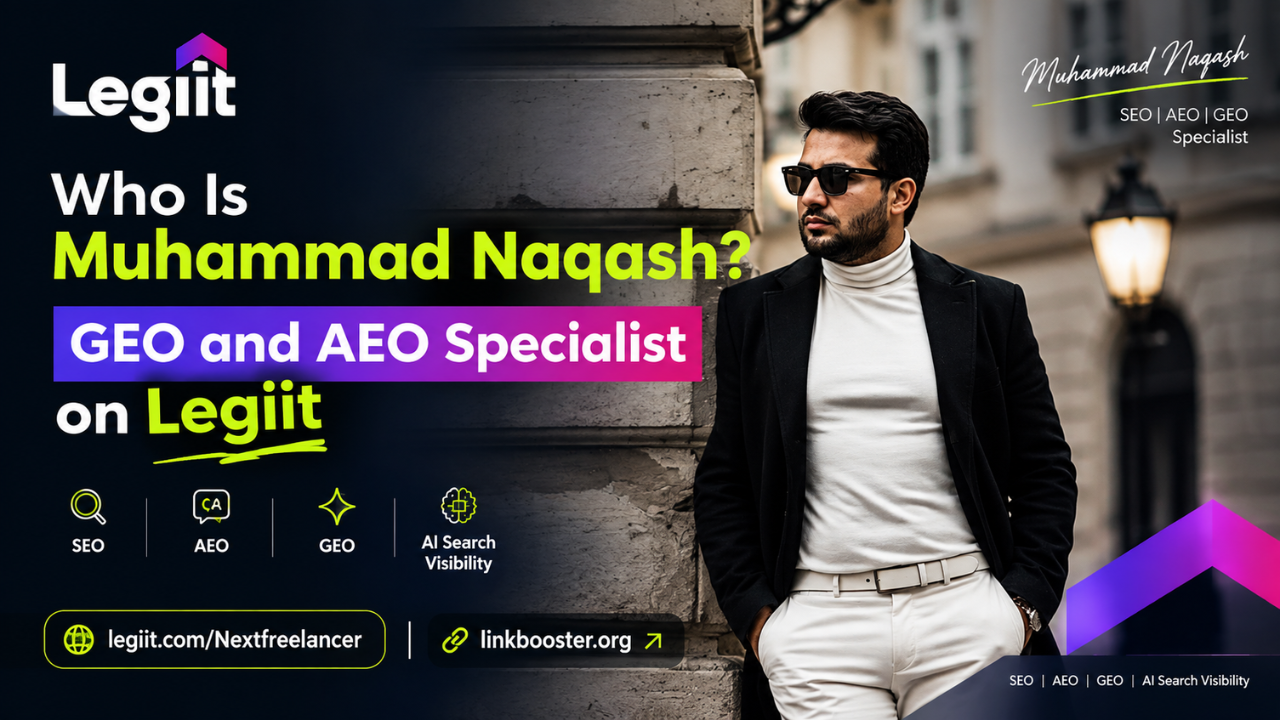
Muhammad Naqash is an SEO, AEO and GEO specialist from Pakistan who works with businesses, websites and brands to improve their visibility across traditional search and AI powered search experiences. He is known on Legiit as Nextfreelancer and also works through LinkBooster, where his work focuses on SEO, Answer Engine Optimization, Generative Engine Optimization, semantic content and broader AI search visibility.
Who Is Muhammad Naqash?
If you found this page because you searched for Muhammad Naqash GEO expert, Muhammad Naqash SEO specialist, or Nextfreelancer on Legiit, this article is written to give you a straightforward answer.
I am Muhammad Naqash, an SEO, AEO and GEO specialist from Faisalabad, Pakistan. Online, many people know me as Nextfreelancer, especially through my work on Legiit.
My work started with traditional SEO. Over time, I worked across different areas of search optimization, including on page SEO, off page SEO, link building, content strategy and semantic content. As search changed, my work also changed.
Today, I focus heavily on the relationship between traditional SEO, Answer Engine Optimization and Generative Engine Optimization.
That change did not happen because I simply decided to add the words AEO and GEO to my service description.
It happened because I started seeing a real problem.
A website could rank in Google and still have very little visibility when people asked questions through AI systems.
A page could contain the right keyword but still fail to provide a clear answer.
A business could have good content but lack the supporting information, entity signals, mentions and context needed for modern search systems to understand what the business actually does.
That is the area I became increasingly interested in.
My goal today is not simply to help a website rank for one keyword.
My goal is to help make the information around a brand easier for search engines, answer engines and AI systems to understand.
That is where my SEO, AEO and GEO work comes together.
My SEO Journey
I started learning SEO in 2021.
Like many people who enter SEO, I initially looked at rankings, keywords and backlinks.
At that stage, SEO can look quite simple from the outside.
Find a keyword.
Create a page.
Build some links.
Wait for rankings.
But working with real websites teaches you very quickly that SEO is not that simple.
Different websites have different problems.
Sometimes the content is the problem.
Sometimes the technical foundation is weak.
Sometimes the website has good content but very little authority.
Sometimes the keyword is wrong.
Sometimes the search intent does not match the page.
Sometimes the website is targeting a keyword that looks valuable in a keyword tool but does not actually match what the customer wants.
And sometimes the website has information that could be useful but it is presented in a way that makes it difficult for both users and search systems to understand.
This is where I gradually became more interested in the meaning behind content rather than simply the number of times a keyword appeared on a page.
That led me deeper into semantic SEO.
What Semantic SEO Taught Me
Semantic SEO changed the way I look at content.
Instead of asking only:
“What keyword should I put on this page?”
I started asking:
“What does the searcher actually need to know?”
Those are two very different questions.
For example, imagine someone searches:
“GEO expert”
That person may want to know several things.
What is GEO?
What does a GEO expert actually do?
How is GEO different from SEO?
Does GEO involve Google AI Overviews?
Does it involve ChatGPT?
How can a business measure AI visibility?
What should a business look for before hiring someone?
What kind of experience does the specialist have?
What services are included?
What evidence exists that the person actually works in this field?
A page that only repeats the phrase “GEO expert” is not really answering those questions.
A useful page needs to cover the topic around the main concept.
That is the basic idea behind semantic SEO.
I use this same thinking when working on AEO and GEO.
The goal is not keyword repetition.
The goal is understanding.
Why I Started Focusing on AEO and GEO
Search has changed significantly.
People still use traditional search engines, but they also increasingly ask questions in conversational interfaces and AI powered search experiences.
Google has introduced AI generated search experiences, while platforms such as ChatGPT can provide answers with links to web sources. OpenAI describes ChatGPT search as a way to connect users with original content on the web and provide sources alongside responses.
This creates a new question for businesses.
It is no longer enough to ask:
“Can people find my website?”
We also need to ask:
“Can search and AI systems understand what my website and brand are about?”
And another question is becoming increasingly important:
“When an AI system answers a question related to my industry, is my brand part of the information it can discover and reference?”
That is where AEO and GEO become useful concepts.
What Is AEO?
AEO stands for Answer Engine Optimization.
In simple terms, AEO focuses on creating and structuring information so that it can clearly answer questions.
Traditional SEO often starts with keywords.
AEO starts heavily with questions and answers.
For example:
Instead of only targeting:
“GEO services”
an AEO focused content strategy might also address:
What are GEO services?
What does a GEO expert do?
How does GEO differ from SEO?
How can a business improve AI search visibility?
How can you measure AI visibility?
The answer should be direct.
It should not force the reader to go through five paragraphs before discovering the actual answer.
That is why I like putting a direct answer near the beginning of important informational articles.
It is useful for humans.
It is also easier for search systems to process.
What Is GEO?
GEO stands for Generative Engine Optimization.
The term is used to describe strategies focused on improving the way a brand, website or information source can appear within generative AI and AI powered search experiences.
I do not look at GEO as a replacement for SEO.
I look at it as another layer of modern search visibility.
Traditional SEO helps search engines discover, crawl, understand and rank web pages.
AEO focuses strongly on providing direct answers to questions.
GEO focuses on visibility within generative search and AI generated responses.
These areas overlap.
A strong technical SEO foundation can help discovery.
Useful and well structured content can help understanding.
Clear answers can improve usability.
Strong brand information and supporting references can help establish context.
That is why I prefer thinking about SEO, AEO and GEO as connected parts of a larger visibility strategy.
My Approach to GEO
My approach to GEO has developed through working with real websites, content projects and SEO campaigns.
I do not believe that GEO is simply about putting a keyword into an article and hoping an AI system will mention the brand.
There are several layers that I look at.
1. Clear Brand Information
The first question is simple.
Who are you?
If information about a business is unclear or inconsistent, it becomes harder to build a strong entity around that business.
The name should be consistent.
The services should be clear.
The website should explain what the company does.
The people behind the company should be identifiable where appropriate.
Important profiles should not contradict each other.
This is especially important for personal brands.
If my website says one thing, my professional profiles say something completely different, and third party pages describe me in another way, the overall picture becomes less clear.
For my own entity, I want the relationship to be understandable:
Muhammad Naqash
SEO, AEO and GEO specialist
Nextfreelancer
My identity on Legiit
LinkBooster
A platform and business environment through which I work on SEO, AEO and GEO related services
That consistency matters.
2. Topic Depth
The second part is topical coverage.
One article about GEO does not make someone an authority on GEO.
If I publish a GEO guide, I should also be able to explain related subjects.
For example:
What is GEO?
How does GEO work?
What is AEO?
How does AEO differ from GEO?
How does GEO relate to SEO?
How can businesses improve AI search visibility?
What is an AI Overview?
How can a business monitor AI visibility?
What makes content easier to understand?
How should an organization structure its information?
These topics create a connected knowledge base.
That is much more useful than publishing dozens of unrelated articles simply because they have search volume.
3. Semantic Relationships
This is where semantic SEO becomes particularly important.
A page about GEO should naturally connect with concepts such as:
AI search
generative AI
Google AI Overviews
ChatGPT
Perplexity
Gemini
search intent
entities
structured data
content quality
semantic relevance
topic authority
citations
brand mentions
content structure
These terms should not be inserted artificially.
They should appear because they are genuinely relevant to the subject.
That is the difference between semantic optimization and keyword stuffing.
4. Direct Answers
When I write content for AEO and GEO, I like to answer the primary question early.
For example:
What is GEO?
GEO is the practice of improving a brand’s information and content so that it is easier for generative AI and AI powered search systems to understand, use and potentially reference when answering relevant questions.
Then the article can go deeper.
This structure works well for readers because someone who wants the quick answer gets it immediately.
Someone who wants to understand the subject can continue reading.
My Experience With Content and AI Search
One of the biggest lessons I have learned is that publishing content is not the same as building visibility.
You can publish twenty articles and still have a weak information ecosystem.
Why?
Because the articles may not connect with each other.
They may target unrelated subjects.
They may repeat the same information.
They may have no clear author identity.
They may not demonstrate first hand experience.
They may contain no original observations.
They may have no supporting references.
They may not clearly explain the business behind the content.
This is why I prefer building content around a topic cluster.
For example, if the main subject is GEO, one strong pillar page can explain what GEO means.
Supporting pages can cover GEO checklists, GEO audits, GEO for ecommerce, GEO for local businesses, AI citations and GEO measurement.
Those pages can then connect naturally.
The result is not simply a collection of blog posts.
It becomes a knowledge structure.
Why First Hand Experience Matters
This is probably the most important part of the way I want to publish my own content.
I do not want to write articles that sound like they were copied from ten other SEO blogs.
There is already enough generic SEO content online.
When I write about GEO, I want to explain what I have actually observed.
When I write about AEO, I want to explain how I approach it.
When I write about content publishing, I want to explain what I have learned from doing it.
When I publish a case study, I want to use real information.
If something worked, I can explain it.
If something did not work, I can explain that too.
That second part is important.
Real SEO work does not mean everything succeeds.
Sometimes an approach does not produce the expected result.
Sometimes a platform changes.
Sometimes a page takes longer to gain visibility.
Sometimes a strategy needs to be changed.
Those experiences are useful because they help other people avoid repeating the same mistakes.
I Do Not Believe in Fake GEO Claims
The AI search industry is still developing, and there are many strong claims being made about what can supposedly guarantee AI visibility.
I am careful with that.
I do not believe anyone should promise guaranteed ChatGPT citations, guaranteed AI Overview placement or guaranteed mentions across every AI platform.
AI systems change.
Search results change.
Sources change.
User queries change.
The information available to an AI system changes.
A responsible GEO strategy should therefore focus on improving the quality, clarity, relevance and discoverability of information rather than selling a guaranteed position.
That is also how I approach SEO.
There is no magic button.
There is no single backlink that guarantees rankings.
There is no single article that guarantees an AI citation.
There is strategy, execution, testing, measurement and refinement.
My Work on Legiit
I am known on Legiit as Nextfreelancer.
My Legiit work covers SEO related services, including content publishing, AEO and GEO related services and other forms of online visibility work. My profile also includes customer reviews and completed order history that reflect my freelance work on the platform.
For me, Legiit has been more than simply a place where I list services.
It has given me the opportunity to work with different types of buyers and different SEO requirements.
Every project teaches something.
One client may need backlinks.
Another may need content.
Another may need a complete SEO strategy.
Another may be more interested in AI search visibility.
That variety helped me understand that there is no universal SEO package that works for every business.
The strategy has to start with the website, the market, the audience and the actual search intent.
Why I Also Focus on LinkBooster
Alongside my freelance identity on Legiit, I also work around the LinkBooster brand.
LinkBooster focuses on SEO, AEO and AI search related visibility.
The reason I see value in having both a personal identity and a business environment is simple.
People want to know the person behind the work.
At the same time, businesses often need a structured service environment.
That is why I do not want my online identity to be based on one profile alone.
My goal is to build a connected but understandable presence across my website, professional profiles, Legiit and relevant business properties.
My LinkedIn Presence
LinkedIn is another important part of my professional identity.
My LinkedIn profile represents me as Muhammad Naqash rather than simply as a marketplace seller.
I use it to discuss SEO, AEO, GEO, AI search, content strategy and digital marketing.
I also share practical observations from my work.
For a personal entity, this is important because an online identity should not depend entirely on one website.
If someone searches for my name, I want the information they find to make sense.
They should be able to understand who I am, what I work on and where they can find more information.
My LinkedIn profile is available here: https://www.linkedin.com/in/nakshonline
What Does a GEO Expert Actually Do?
This is a question I think businesses should ask before hiring anyone.
A GEO expert should not simply publish AI related articles and call that GEO.
The work can involve several areas.
First, there is the existing website.
What does it say?
Is the information clear?
Are important entities and relationships understandable?
Does the content satisfy search intent?
Are important questions answered?
Then there is the content ecosystem.
Are the major topics covered?
Are supporting topics connected?
Is there enough depth?
Does the content demonstrate experience?
Then there is the external information environment.
Are there relevant mentions?
Are professional profiles consistent?
Does the brand have supporting information outside its own website?
And finally, there is measurement.
What visibility existed before?
What changes after implementation?
Which queries are being monitored?
Which platforms matter to the client?
This is why I see GEO as a process rather than a single task.
How I Would Start a GEO Project
If a business came to me today and said:
“Muhammad, I want my brand to appear more often in AI search.”
I would not immediately tell them to publish 100 articles.
I would start with an audit.
Step 1: Understand the Brand
I need to know what the company does.
Who does it serve?
What products or services does it provide?
What makes it different?
Who are its competitors?
Which markets does it target?
Step 2: Review Existing Search Visibility
I want to understand what is already working.
Which pages receive traffic?
Which keywords have visibility?
Which pages have authority?
Where are the content gaps?
Step 3: Review AI Search Visibility
I would create a relevant set of questions around the brand and its market.
The purpose is not to pretend that one measurement represents all AI systems.
The purpose is to establish a baseline.
Step 4: Improve the Information
Then I would work on the website and content.
This may involve improving existing pages rather than creating new ones.
That distinction is important.
Sometimes the best SEO page is already on the website.
It simply needs better structure, better information and better alignment with search intent.
Step 5: Build Supporting Content
After fixing the foundation, supporting content can be created around important topics.
This is where topical authority becomes useful.
Step 6: Strengthen the Brand Footprint
Relevant professional profiles, business information, publications and other legitimate mentions can help create a clearer online footprint.
The goal is not to create fake mentions.
The goal is to make the real business easier to understand across the web.
Step 7: Measure and Refine
Finally, measure what changes.
SEO and AI visibility should be treated as ongoing processes.
What Makes My Approach Different?
I would not describe my work as having one secret trick.
The main difference is the way I connect the pieces.
I look at:
SEO
Can search engines discover and understand the website?
AEO
Can the content answer important questions clearly?
GEO
Can the information become useful to generative search systems?
Semantic SEO
Does the content cover the subject deeply enough and connect related concepts naturally?
Entity optimization
Is it clear who the brand or person is?
Content distribution
Does useful information exist in more than one relevant place?
Measurement
Can we actually observe what changed?
That combination is more meaningful to me than chasing one metric.
What I Want Readers to Learn From My Content
If you are reading my articles because you are interested in SEO, AEO or GEO, I do not want you to simply trust me because I call myself an expert.
I want you to learn enough to evaluate the strategy yourself.
If someone tells you:
“I can guarantee ChatGPT will recommend your company.”
Ask how.
If someone says:
“Buy these backlinks and you will appear in AI Overviews.”
Ask for evidence.
If someone says:
“Publish 100 AI articles and your brand will become an AI authority.”
Ask whether those articles actually provide unique information.
The more you understand the process, the easier it becomes to recognize unrealistic SEO and GEO promises.
That is one of the reasons I am building this content library.
I want to share what I know, what I test, what I observe and what I learn from real projects.
My Philosophy About SEO, AEO and GEO
My approach can be summarized very simply.
Be useful first.
Then make that usefulness easy to understand.
Then make the information easy to discover.
Then build supporting evidence around the brand.
Then measure the results.
I still believe traditional SEO matters.
I still believe technical SEO matters.
I still believe content matters.
I still believe links and authority matter.
But modern search requires us to think beyond the traditional ten blue links.
People are asking questions in more places.
Search interfaces are becoming more conversational.
AI systems can synthesize information from multiple sources.
That means businesses need to think about their information ecosystem, not just individual rankings.
If You Are Looking for a GEO Expert
If you are searching for a GEO expert on Legiit, do not choose someone simply because they use the term GEO in their profile.
Look at their actual work.
Check their content.
Look at their SEO experience.
Read reviews.
Ask how they measure AI visibility.
Ask what they would change on your website.
Ask whether they can explain the difference between SEO, AEO and GEO.
Most importantly, ask whether the strategy is based on your business or simply a prebuilt package.
That is the same advice I would give to any business owner considering an SEO service.
You should understand what you are buying.
Where You Can Find Me
If you want to learn more about my work or contact me, these are the main places where you can find me.
I use these platforms for different parts of my professional presence, but the underlying identity is the same.
Muhammad Naqash.
SEO, AEO and GEO specialist.
Frequently Asked Questions
Who is Muhammad Naqash?
Muhammad Naqash is an SEO, AEO and GEO specialist from Pakistan. He is known as Nextfreelancer on Legiit and works on SEO, content, AEO, GEO and AI search visibility.
Is Muhammad Naqash a GEO expert?
Muhammad Naqash works specifically on Generative Engine Optimization and AI search visibility alongside traditional SEO and AEO. His work includes content strategy, semantic content, entity focused optimization and visibility strategies for AI search.
What is Nextfreelancer on Legiit?
Nextfreelancer is the Legiit profile used by Muhammad Naqash. The profile offers SEO related services, including AEO and GEO related content and visibility services.
What does a GEO expert do?
A GEO expert works on improving how a brand’s information is structured, understood and discovered within generative AI and AI powered search experiences. This can include content, semantic SEO, entity information, brand mentions, technical foundations and measurement.
Does GEO replace SEO?
No. GEO does not need to replace SEO. A strong GEO strategy can work alongside traditional SEO and AEO. SEO remains important for technical accessibility, organic search visibility and website discovery, while AEO and GEO address additional ways people and AI systems interact with information.
Final Thoughts
I did not start my career by calling myself a GEO expert.
I started with SEO.
I learned through projects.
I made mistakes.
I tested strategies.
I worked with different types of websites.
I learned that a keyword by itself does not build authority.
I learned that publishing more content does not automatically mean better visibility.
I learned that links need context.
I learned that search intent matters.
And as search evolved, I started paying much more attention to how information is understood beyond traditional search results.
That is what led me deeper into AEO and GEO.
Today, when I work on a website, I do not want to look at only one ranking position.
I want to understand the bigger picture.
Can the website be found?
Can the content answer the question?
Can the subject be understood?
Is the brand clearly identified?
Are the important concepts connected?
Does the website demonstrate real experience?
Is there supporting information elsewhere?
Can we measure what is happening?
Those questions form the foundation of how I think about modern search visibility.
And that is the approach I will continue sharing through my SEO, AEO and GEO content.
Not theory copied from somewhere else.
Not guaranteed rankings.
Not artificial claims.
Just practical strategies, real experiences, documented results where available, and lessons that can help businesses understand how search is changing.
1 Comment
Post a Comments
Your email address will not be published. Required fields are marked *
LET'S BUILD
YOUR AI SYSTEM




 INTELLIGENT AUTOMATION
GLOBAL SUPPORT
INTELLIGENT AUTOMATION
GLOBAL SUPPORT
My Work as a GEO and AEO Specialist on Legiit: What I Have Learned From Real SEO Projects - LinkBooster
October 1, 2026 at 6:51 pm
" […] you searched for GEO and AEO Specialist on Legiit, you may have reached this article because you want to understand who I am, what I actually do, and […] "