
WE ARE AVAILABLE FOR DECEMBER PROJECTS


Muhammad Naqash SEO Journey, Freelance Growth & AI Search Strategy Case Study



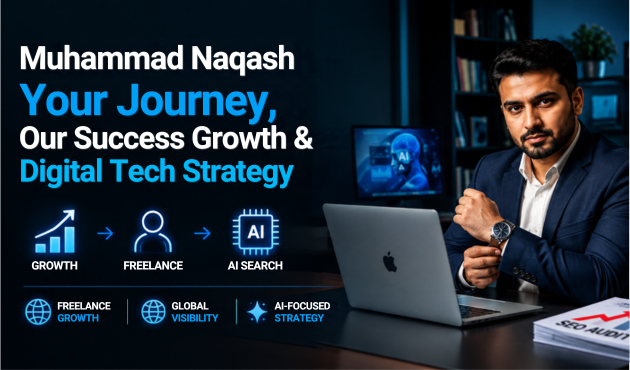
An AI Search Strategy Case Study is not just about using AI tools or adding a few keywords to an article. For me, it represents a gradual shift from traditional SEO toward understanding how people discover information through Google, answer engines, and AI-powered search platforms.
My own journey started with a much simpler question: why do some websites appear prominently in Google while others struggle to get visibility?
That question eventually became the foundation of my SEO career.
My name is Muhammad Naqash. I work in SEO and digital marketing, and over the years I have moved from traditional search optimization toward AEO, GEO, entity optimization, and AI search visibility.
This AI Search Strategy Case Study documents that journey, including what I learned from real SEO projects, how I built my freelance practice, why I started studying AI search, and how those experiences led me to develop my own approach called Hybrid Engine Optimization, or HEO.
I am sharing the process because my experience has not been a straight line. It has involved testing, mistakes, experimentation, successful campaigns, failed ideas, and continuous learning.
Where My SEO Journey Started
I did not begin SEO with formal training or a detailed career plan.
I started because I was curious.
I wanted to understand why one website could appear at the top of Google while another website covering a similar topic received very little visibility.
That curiosity pushed me toward Google’s documentation, SEO blogs, case studies, industry discussions, and practical testing.
I experimented with websites myself and gradually started understanding how different SEO elements worked together.
Not every experiment produced results.
Some pages failed to rank even when I expected them to perform well. Some content received almost no traffic. Some strategies that looked effective in theory did not work the same way on real websites.
Those failures became part of my education.
Instead of simply copying SEO tactics, I started asking a different question:
Why did this work, and why did that fail?
That mindset became one of the most important parts of my SEO development.
I began understanding the relationship between content quality, search intent, website structure, internal linking, relevance, authority, and backlinks.
Over time, I learned that sustainable SEO is not simply about finding shortcuts.
It is about making a website easier for search engines and users to understand while providing genuinely useful information.
Learning SEO Through Real Client Projects
My first clients were mostly smaller businesses, local service providers, and e-commerce websites.
These businesses did not always have large SEO budgets.
Most of them had a simple objective: get more relevant people to discover their websites.
Working with these businesses taught me practical SEO in a way that theory alone could not.
I had to prioritize.
There was rarely enough budget or time to implement every possible SEO recommendation.
That meant identifying which changes could have the most meaningful impact.
I learned that basic SEO fundamentals can be extremely powerful when implemented correctly.
Clean website structure, useful content, internal linking, technical improvements, relevant backlinks, and proper search intent alignment can make a significant difference over time.
This lesson still influences my work today.
Building My Freelance SEO Career
Turning SEO knowledge into a freelance business was another challenge entirely.
Knowing how to optimize a website did not automatically teach me how to find clients, price services, communicate results, manage projects, or build a reputation.
I started offering SEO services on Legiit.
Initially, my services were broad.
I worked around areas such as keyword research, on-page SEO, metadata, content optimization, and backlink-related services.
But I soon realized that generic SEO positioning made it difficult to stand out.
If everyone is selling “SEO services,” clients can easily compare providers primarily on price.
I did not want to build my freelance career around being the cheapest option.
So I started specializing.
My services became more focused around specific SEO problems and outcomes.
Over time, I moved toward content optimization, featured snippet opportunities, AEO, GEO, and eventually AI search visibility.
That change affected the conversations I had with potential clients.
Instead of discussing SEO as one large category, I could discuss a specific visibility problem and the strategy required to address it.
The Importance of Client Communication
One of the biggest lessons from freelancing was that SEO knowledge alone is not enough.
You also need to communicate clearly.
SEO results often take time.
Clients may not immediately understand why a particular keyword was selected or why a page needs to be rewritten.
They may also question why internal links are being changed or why specific websites are being considered for digital PR or link acquisition.
I started explaining the reasoning behind my recommendations.
Instead of simply telling clients what I was doing, I explained why I was doing it.
That approach helped me build trust.
It also changed the nature of client relationships.
A client who understands the strategy is generally better positioned to evaluate the work than a client who only sees a list of completed tasks.
How Content and Personal Branding Supported My Freelance Growth
I also started publishing what I was learning.
I used platforms such as LinkedIn, Medium, dev.to, and other publishing communities to document ideas, SEO observations, and practical experiences.
Writing publicly helped me in two ways.
First, it forced me to organize my thoughts.
Second, it created a public record of my experience and areas of specialization.
This became an important part of my personal brand.
Instead of simply telling potential clients that I understood SEO, I could show them how I approached specific problems.
That lesson became even more important when I started focusing on AI search.
The Turning Point: Discovering AI Search
Around 2023 and 2024, I began noticing a pattern that changed the direction of my work.
Some websites were performing well in traditional Google search but were not appearing prominently when similar questions were asked through AI platforms.
A website could rank well for a topic in Google while another source was being referenced by ChatGPT or Perplexity.
That made me curious.
Why were traditional search rankings and AI-generated answers not always producing the same sources?
At first, I considered AI search an emerging development that would take time to mature.
But as I continued observing it, the differences became increasingly interesting.
AI systems do not simply present a ranked list of webpages.
They can synthesize information from different sources and generate an answer.
That created a new SEO question:
What makes content easier for AI systems to understand, retrieve, and potentially cite?
This became the foundation of my AI Search Strategy Case Study.
My AI Search Strategy Case Study
My approach to AI search did not begin with one single technique.
It developed through experimentation.
I tested different content structures, entity relationships, schema implementations, direct-answer formats, and ways of presenting information more clearly.
I also examined the types of websites and pages that appeared in AI-generated answers.
One recurring observation was that clarity matters.
Content needs to communicate its subject clearly.
Important answers should not always be hidden behind long introductions.
Claims should have supporting context.
Entities should be clearly connected to the subjects they represent.
Author, company, brand, and topic information should remain consistent across relevant sources.
These observations gradually changed the way I approached content strategy.
Instead of optimizing only for a keyword and a traditional search ranking, I started thinking about how the underlying information could be understood across multiple discovery systems.
What I Learned From AI Search Experiments
The more I experimented, the more I saw common principles between traditional SEO and AI search.
Clear content helps humans.
Clear content can also help machines.
Strong topical organization helps users navigate information.
It can also make relationships between concepts easier to interpret.
Useful evidence helps readers evaluate claims.
It can also give AI systems more context when processing information.
Entity clarity helps establish what a person, company, product, organization, or topic actually represents.
These observations became the foundation for the framework I later called Hybrid Engine Optimization.
What Is Hybrid Engine Optimization?
I developed Hybrid Engine Optimization as a way to organize the strategy I was already using across different projects.
The framework considers three major discovery environments.
Traditional Search
This includes Google, Bing, and other search engines that primarily present algorithmically ranked webpages.
Generative AI Search
This includes AI-powered systems such as ChatGPT Search, Perplexity AI, and Google’s AI Overviews that can synthesize information from online sources.
Answer and Voice Search
This includes featured snippets, direct-answer results, and voice assistants that can provide information without requiring the user to visit multiple search results.
Traditional SEO has historically focused heavily on the first category.
My approach is to consider all three.
The reason is that the search journey itself is changing.
Users can move between traditional search, AI assistants, and answer engines depending on what they need.
Why SEO and AI Search Should Not Be Treated as Completely Separate
One of the most important lessons from my AI Search Strategy Case Study is that traditional SEO and AI search optimization have significant overlap.
You do not necessarily need two completely different content strategies.
A well-structured page can serve multiple purposes.
It can be useful to a human reader.
It can be crawled and understood by traditional search engines.
And its information can potentially be easier for AI systems to interpret.
This is why I focus heavily on semantic structure, entity relationships, evidence, internal linking, structured information, and clear answers.
The goal is to make the information understandable across different discovery environments.
How I Structure Content for AI Search Visibility
One of the biggest changes I made was the way I structure articles.
Traditional articles often begin with a long introduction and gradually move toward the main answer.
That can work for some readers.
However, when I am creating content designed for AI search visibility, I prefer making the central answer easy to identify early in the article.
I generally use a five-part structure.
1. Definition
Start with a direct explanation of the primary question or topic.
The reader should quickly understand what the page is about.
2. Context
Explain why the subject matters and provide the necessary background.
3. Evidence
Support important claims with data, examples, references, or other relevant evidence.
4. Example
Give the reader a practical example that demonstrates the concept.
5. Implication
Explain what the information means and what the reader should understand or consider next.
This structure makes an article easier to scan and gives important information a clearer position within the content.
The Answer Block
One particular technique that became important in my content strategy is what I call the Answer Block.
The idea is simple.
Instead of making readers or AI systems search through several paragraphs to discover the answer, provide a concise answer near the beginning.
For many informational topics, I use a direct answer of roughly 40 to 70 words before expanding into context and supporting details.
This is not about writing exclusively for machines.
It is about respecting the user’s time.
A reader should be able to understand the main answer quickly and then continue reading if they want deeper information.
Building the AI Visibility and LLM Rank Analyzer
Once I became more involved in AI search, another problem became obvious: measurement.
Traditional SEO provides many established metrics.
Google Search Console provides search impressions and clicks.
SEO platforms can provide keyword rankings, backlinks, and other measurements.
AI search visibility is harder to measure consistently.
There is no single universal dashboard that tells you exactly how often a brand is referenced across every AI system.
So I decided to build a tool for my own work.
I called it the AI Visibility and LLM Rank Analyzer.
The tool uses structured queries across multiple AI systems, including ChatGPT, Perplexity, and Gemini, and analyzes the responses to identify whether a brand, website, content asset, or entity appears.
The purpose is to make AI search visibility more measurable.
Instead of simply saying that a brand “should appear in AI search,” I wanted to examine actual responses and identify patterns.
How the Analyzer Helps With Strategy
The tool is not only about reporting.
It can also support strategic decisions.
If certain topics consistently produce mentions while others do not, that information can influence content planning.
If competitors are repeatedly appearing for a particular set of questions, those queries can become useful research points.
If a brand is visible for some topics but absent from others, that gap can help identify areas for further optimization.
This turns AI search research into a more structured process.
It does not eliminate uncertainty, but it gives me data to work with.
Cross-Platform Entity Building
Another important part of my AI search strategy is entity building.
An AI system does not necessarily evaluate a brand by looking at one website alone.
Information can exist across many sources.
A brand may have a website, LinkedIn profile, Medium articles, social profiles, directory listings, interviews, community discussions, and other online references.
When those sources consistently describe the same entity and its areas of expertise, they contribute to a broader digital presence.
This is why I use cross-platform entity building as part of certain client strategies.
Depending on the project, platforms can include Medium, dev.to, Hackernoon, Hashnode, LinkedIn, Quora, Reddit, and other relevant websites.
The objective is not simply to collect backlinks.
Backlinks can be a useful secondary benefit, but the broader objective is consistency.
The brand should be represented accurately across relevant sources.
The person should be associated with the topics they genuinely work in.
The organization should have a clear and consistent identity.
What I Learned About Freelance Growth
My freelance journey has not been a straight upward line.
There have been periods when client acquisition was difficult.
There were months when income was inconsistent.
There were projects that did not produce the outcomes I expected.
There were clients who were unhappy with results.
And there were strategies I believed in that had to be changed after testing.
These experiences taught me that sustainable freelance growth rarely comes from one clever tactic.
It comes from consistent improvement.
Learn the skill.
Improve the service.
Communicate better.
Document the results.
Build relationships.
Develop a specialization.
Keep learning.
Over time, these activities compound.
Why AI Search Became an Important Specialization
The move into AI search was one of the most significant changes in my freelance career.
But I did not want to treat AI search as simply another marketing trend.
I wanted to understand the underlying problem.
How do AI systems discover information?
How do they interpret entities?
Why does one source appear in an answer while another does not?
How can content be structured so that the main information is easier to understand?
How can AI visibility be measured?
Those questions became the foundation of my work.
Specialization also changed how I positioned my services.
Instead of simply saying that I provide SEO, I could talk about a specific emerging search problem.
That gave potential clients a clearer understanding of what I actually do.
Results From My AI Search Strategy Case Study
Across the client projects described in my original case study, the HEO framework produced improvements in organic visibility, featured snippet performance, and AI citation activity.
The reported organic search improvement across selected engagements was approximately 180 to 220 percent within 90 days of full implementation.
AI citation activity was also tracked through my LLM Rank Analyzer, with selected projects moving from little or no measurable citation visibility to measurable levels within approximately 60 to 90 days after implementing the broader strategy.
These results should not be interpreted as guaranteed outcomes.
Every website is different.
Competition, content quality, technical SEO, existing authority, industry, search demand, implementation quality, and starting position can all influence the results.
For me, the important part of the case study is not simply the percentage increase.
It is the process behind it.
The strategy developed through research, testing, observation, measurement, and refinement.
Key Lessons From My AI Search Strategy Case Study
Looking back at the work, several lessons stand out.
Search Is Becoming More Diverse
Users are no longer limited to traditional search results.
AI assistants, answer engines, and other discovery systems are becoming part of the information journey.
Clear Information Matters
Whether the reader is a human or an AI system, unclear information creates unnecessary friction.
Entities Matter
A brand, expert, product, or organization should have a consistent identity across relevant online sources.
Content Structure Matters
The way information is organized can influence how easily it can be understood, extracted, summarized, and referenced.
Measurement Is Important
AI search should not be treated entirely as an abstract concept.
Testing actual AI responses can provide useful evidence for strategy development.
SEO Fundamentals Still Matter
AI search does not make traditional SEO irrelevant.
Technical accessibility, useful content, relevance, authority, internal linking, and a strong website remain important foundations.
Frequently Asked Questions
What is an AI Search Strategy Case Study?
An AI Search Strategy Case Study documents how AI search optimization is researched, implemented, tested, and measured on real projects.
In my case, it covers my transition from traditional SEO into AI search visibility, including content structure, entity building, measurement, and the development of Hybrid Engine Optimization.
How did Muhammad Naqash start learning SEO?
I started by trying to understand why some websites ranked higher in Google than others.
I learned through self-study, experimentation, SEO documentation, industry content, testing, and eventually working with real clients.
What is Hybrid Engine Optimization?
Hybrid Engine Optimization is the framework I developed to consider traditional search, generative AI search, and answer or voice search together.
The approach focuses on areas such as semantic content structure, entity clarity, structured information, and cross-platform digital presence.
What is the most important lesson from your AI Search Strategy Case Study?
The biggest lesson is that information needs to be clear, structured, and supported by useful context.
AI search optimization is not simply about inserting keywords.
It requires thinking about how information, entities, evidence, and relationships can be understood across different discovery systems.
How do you measure AI search visibility?
I use my AI Visibility and LLM Rank Analyzer to send structured queries to multiple AI systems and analyze whether a client’s brand, content, or entity appears in the responses.
This provides a more practical way to monitor AI search visibility.
Does AI search replace traditional SEO?
No.
Traditional SEO remains an important foundation.
My approach is to build on traditional SEO while also considering how users increasingly discover information through AI-powered systems and answer engines.
Is this AI search strategy suitable for small businesses?
The underlying principles can also be applied to smaller businesses.
Clear content, strong topical relevance, entity consistency, structured information, and useful digital mentions do not necessarily require a large SEO budget.
They require careful planning and consistent execution.
What I Know Now That I Did Not Know When I Started
If I could go back to the beginning of my SEO career, I would give myself one simple piece of advice:
Pay attention to where search is going, not only where it is today.
When I started learning SEO, search looked very different.
The core principles of relevance, authority, usefulness, and quality remain important, but the systems through which people discover information continue to evolve.
AI-powered search is one of the biggest developments in that evolution.
Nobody can know exactly how search will look several years from now.
But SEO professionals can study the changes, test new approaches, measure what happens, and adapt.
That is what I have tried to do throughout my career.
I started by learning traditional SEO.
I built my freelance practice through real client work.
I studied AEO and GEO.
I began researching how AI systems discover and cite information.
And eventually, those experiences led me to develop my own AI search strategy and the Hybrid Engine Optimization framework.
This AI Search Strategy Case Study is therefore not the story of one successful campaign.
It is the story of an ongoing learning process.
I am Muhammad Naqash.
This is my SEO journey so far, and there is still much more to test, learn, and build.
LET'S BUILD
YOUR AI SYSTEM




 INTELLIGENT AUTOMATION
GLOBAL SUPPORT
Post a Comments
Your email address will not be published. Required fields are marked *