
WE ARE AVAILABLE FOR DECEMBER PROJECTS


Marko Oolo: Investor, Entrepreneur, Financial Educator and His Approach to Wealth Building



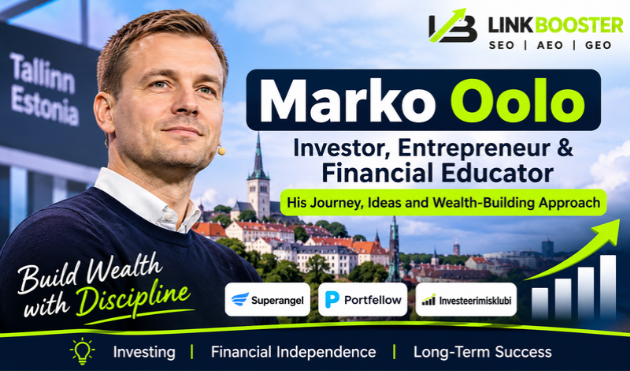
When people search for Marko Oolo, they are often looking for more than a basic biography. They may want to understand who he is, how he built his investment portfolio, what he does in the investment industry, what companies and platforms he is associated with, and what ideas he shares about building long-term wealth.
Marko Oolo is an Estonian investor, entrepreneur and financial education advocate based in Tallinn. His professional career connects personal investing, venture capital, financial technology, portfolio management and financial education.
His own website describes him as an investor, entrepreneur and father, while his professional activities include working as a partner at the venture capital fund Superangel and co-founding Portfellow, a portfolio-management software platform. He also has a public role in financial education and regularly discusses investing, wealth creation, business and personal development.
Marko Oolo is particularly known in Estonia for building an investment portfolio of more than one million euros through disciplined saving, investing and long-term financial decision-making. His official biography says that he reached a portfolio value of more than €1 million in 2021 after starting his investment journey with relatively small amounts.
This article looks at who Marko Oolo is, his career, investment philosophy, business activities, Portfellow, Superangel, financial education work and the principles he uses when thinking about wealth creation.
Who Is Marko Oolo?
Marko Oolo is an Estonian investor, entrepreneur and financial educator who focuses on long-term investing, wealth building, technology businesses and financial decision-making.
According to his official website, Oolo became interested in investing while studying at university. He made his first deliberate investments in early 2014, beginning with investments of a few hundred euros in the Baltic stock market and crowdfunding. He says that discipline with money, consistent saving, continuous learning and applying knowledge helped him build his investment portfolio over time.
His career has also included work in the technology and financial-services sector.
Before moving further into venture capital, Oolo worked at TransferWise, now known as Wise. His earlier career included roles connected with growth analytics and product management. His own biography explains that his professional path moved from construction-related work toward FinTech and eventually venture capital.
Today, his public professional identity combines several areas:
- Personal investing
- Venture capital
- Financial technology
- Portfolio management
- Financial education
- Entrepreneurship
- Wealth-building strategy
- Investment research
This combination helps explain why the name Marko Oolo appears in discussions about both personal finance and startup investing.
Marko Oolo’s Investment Journey
One of the most interesting aspects of Marko Oolo’s story is that his investment journey did not begin with a large amount of capital.
His official biography says he started investing in 2014 with investments of only a few hundred euros. Over the following years, he focused on saving, learning and applying financial knowledge. By 2021, his investment portfolio had exceeded €1 million.
This background is important because Oolo’s approach is often presented around the idea that wealth creation is a process rather than a single investment decision.
In interviews and presentations, he has discussed three major components of building significant wealth:
initial capital, time and investment returns.
In a 2024 interview, Oolo explained that younger investors may have less starting capital but more time, while older investors may have more capital but less time available for compounding. He also emphasized that increasing income can be important during the early stages of wealth creation, with investment returns becoming increasingly important as capital grows.
This provides a useful framework for understanding his investment philosophy.
Instead of treating investing as a shortcut to wealth, the model is based on combining earning ability, saving discipline, time and investment returns.
What Is Marko Oolo Known For?
Marko Oolo is associated with several areas of the Estonian investment and technology ecosystem.
His official website identifies him as:
Investor
Entrepreneur
Financial education advocate
Superangel partner
Portfellow co-founder
He also founded Investeerimisklubi, an Estonian investment community, according to his LinkedIn profile. LinkedIn describes the organization as an investment community and lists Oolo as its founder.
His public work therefore goes beyond managing his own portfolio.
He has also spoken at investment conferences and appeared in business media discussing portfolio construction, financial independence, income, wealth creation and investment behavior.
This makes him relevant to both experienced investors and people who are still learning the fundamentals of personal finance.
Marko Oolo and Superangel
One of the most important parts of Marko Oolo’s current professional career is his role with Superangel, a venture capital fund focused on technology companies.
Oolo’s official biography states that he works as a partner at Superangel and that the fund invests in technology companies. His profile specifically mentions companies such as Bolt, Veriff, Starship and Salv among the portfolio companies.
This is an important distinction when understanding his career.
Personal investing and venture capital investing involve different types of decisions.
A personal investor may build a portfolio of listed stocks, ETFs or other financial assets.
A venture capital investor, on the other hand, evaluates early-stage companies where the potential return can be significant but the risk of failure is also much higher.
Oolo’s work therefore connects two different parts of the investment world:
public-market and personal investing on one side, and startup and venture capital investing on the other.
That combination gives him exposure to different approaches to capital allocation.
What Is Portfellow?
Portfellow is another important entity associated with Marko Oolo.
Portfellow is a portfolio-management software platform designed to help investors track and manage their investments.
Oolo’s official biography identifies him as a co-founder of Portfellow, while his LinkedIn profile lists Portfellow among his professional activities.
The idea behind portfolio-management software is relatively straightforward.
Investors can have assets distributed across different accounts, markets and asset classes. Tracking those investments manually can become increasingly difficult as a portfolio grows.
A portfolio-management platform can help investors organize information such as:
- Investments
- Portfolio value
- Asset allocation
- Investment history
- Performance
- Transactions
- Returns
Oolo has also spoken publicly about how his own investment tracking evolved.
In an interview about wealth creation, he explained that he initially managed his investments using Excel spreadsheets before moving toward dedicated portfolio-management software. He emphasized the importance of maintaining investment history and organizing information so investors can better understand portfolio performance and make informed decisions.
This reflects one of the recurring ideas in his approach: investment decisions become easier to evaluate when they are measurable and organized.
Marko Oolo’s Approach to Wealth Building
Marko Oolo’s public discussions about wealth tend to go beyond simply selecting investments.
He has described wealth as something broader than investment returns.
In a 2025 presentation, Oolo discussed wealth creation through several dimensions, including investing, entrepreneurship, developing personal skills, building relationships and maintaining a healthy foundation.
This broader perspective is important because financial independence does not depend entirely on portfolio returns.
For many people, the early stage of wealth building is primarily influenced by income and savings.
If someone has a small amount of investable capital, achieving a high investment return may not make a major difference to their overall financial position.
Increasing income, controlling expenses and consistently investing can have a much larger impact.
As capital grows, investment returns and compounding can become more significant.
This is consistent with the framework Oolo has discussed publicly around capital, time and returns.
Discipline and Consistency in Investing
One of the strongest themes associated with Marko Oolo is discipline.
His official website describes discipline with money, consistent saving, continuous learning and applying knowledge as important elements of his investment journey.
This is different from an investment strategy based entirely on predicting short-term market movements.
A disciplined investor may focus more on:
- Long-term goals
- Regular contributions
- Portfolio allocation
- Risk management
- Investment history
- Consistent decision-making
- Learning from previous decisions
This approach does not mean that markets are predictable.
Instead, it places more emphasis on building a repeatable process.
For someone beginning to invest, this can be a useful distinction.
The goal is not necessarily to find one perfect investment. The goal is to develop a system that can continue operating across different market conditions.
Marko Oolo on Financial Independence
Financial independence is another major theme in Oolo’s public work.
His official website lists financial independence as one of his personal goals and describes it as having the freedom to decide when and how to work.
This definition is broader than simply having a large investment account.
Financial independence can involve having enough financial resources and income-producing assets to reduce dependence on active employment.
However, the amount required for financial independence is different for every person.
It depends on factors such as:
- Household expenses
- Desired lifestyle
- Investment returns
- Inflation
- Taxes
- Family responsibilities
- Housing costs
- Healthcare costs
- Risk tolerance
- Other income sources
Oolo has discussed this issue publicly, including why a €1 million portfolio may not automatically mean that someone can stop working permanently.
In a 2024 discussion, he examined portfolio size, spending, returns and lifestyle requirements to question the assumption that one million euros is automatically enough for lifelong financial independence.
The larger lesson is that financial independence should be calculated around personal expenses and sustainable withdrawals, rather than a single universal number.
Why One Million Euros May Not Be Enough
The idea of becoming a millionaire is often treated as the ultimate financial goal.
But Marko Oolo has publicly challenged the assumption that reaching €1 million automatically solves every financial problem.
In his discussion about sufficient portfolio size, he explained that the required amount depends on spending, portfolio returns and the percentage of assets that can reasonably be withdrawn.
For example, two people can both have €1 million invested but have completely different financial situations.
One person might have low annual expenses and another might support a larger household with significantly higher costs.
Therefore, the relevant question is not simply:
“How much money do I have?”
It is also:
“How much do I need, how much does my portfolio produce, and how sustainable is my spending?”
This is one reason portfolio planning is an important part of financial independence.
Marko Oolo and Financial Education
Oolo’s public role also includes financial education.
His official website presents his content as a way of sharing his investment journey, financial ideas and tools that have helped him build his portfolio.
He has participated in investment conferences, podcasts, interviews and educational discussions.
His public topics include:
- How to build wealth
- Investment portfolios
- Financial independence
- Investment mistakes
- Income growth
- Portfolio management
- Long-term investing
- Investment behavior
- Entrepreneurship
- Venture capital
His approach is generally focused on making financial goals measurable and breaking large objectives into smaller actions.
TalTech Business Forum described Oolo as an Estonian investor and financial education advocate who emphasizes data-driven and systematic wealth management. The profile also highlights his focus on discipline, measurable goals and long-term thinking.
Marko Oolo and Investeerimisklubi
Before becoming known primarily through his investment and venture-capital activities, Marko Oolo was also involved in building Estonia’s investment community.
His LinkedIn profile lists him as the founder of Investeerimisklubi, an investment community established in 2014.
Investment communities can play an important role in financial education because they allow investors to share ideas, discuss markets and learn from different experiences.
For newer investors, community-based learning can also help make financial topics less intimidating.
However, investment communities should be treated as educational environments rather than substitutes for personal financial advice.
Every investor has different objectives, income, risk tolerance and financial circumstances.
Marko Oolo’s Career Path
Marko Oolo’s career is interesting because it did not begin directly in investment management.
His official biography says he initially started in construction before moving toward FinTech. He later worked at TransferWise and then moved into venture capital.
An earlier interview provides additional detail about this transition.
Oolo studied in Tallinn after completing his military service and initially worked in a company connected with modular-home exports. He eventually realized that construction was not the right long-term career direction for him.
His interest in investing grew alongside his stable income.
He later spent time in Portugal before returning to Estonia and moving into financial technology.
At TransferWise, he worked in areas including growth analytics and product management. He then joined the venture capital ecosystem.
This career path illustrates how his current interests developed across several connected fields:
construction → technology → FinTech → investing → venture capital → financial education.
What Can Investors Learn From Marko Oolo?
Marko Oolo’s personal story should not be treated as a guaranteed formula for becoming wealthy.
Investment returns are uncertain, and past performance does not guarantee future results.
However, several principles repeatedly appear in his public discussions.
Start with what you have
Oolo began investing with relatively small amounts rather than waiting until he had a large amount of capital.
For beginners, this can be an important psychological lesson.
Waiting for the “perfect” amount of money may delay learning.
Increase your earning ability
Oolo has also emphasized income growth as an important part of wealth creation.
When starting with limited capital, increasing the amount available for investment can sometimes have a larger effect than trying to achieve extraordinary investment returns.
Give investing time
Time is one of the most powerful components of long-term investing because it allows capital and returns to compound.
Track your investments
His transition from Excel-based tracking toward portfolio-management software highlights the importance of maintaining accurate investment records.
Build a repeatable process
Instead of relying entirely on emotions or market predictions, investors can create rules around saving, allocation, research and review.
Think beyond investments
Oolo’s broader definition of wealth includes skills, entrepreneurship, relationships and health in addition to financial assets.
Marko Oolo’s Current Public Profile
Marko Oolo continues to maintain a public presence through his website, professional profiles, investment discussions and financial-education content.
His official website currently describes him as an investor, entrepreneur and father and lists more than 12 years of investing experience, a portfolio above €1.5 million and more than 80 startup investments. These figures are self-reported on his website and can change over time.
His LinkedIn profile identifies him with Portfellow and lists his involvement with Investeerimisklubi.
His Substack profile describes him as a partner in Superangel, an active investor and co-founder of Portfellow.
His public profile therefore sits at the intersection of several areas:
personal finance + investing + venture capital + technology + financial education.
Marko Oolo and the Estonian Investment Community
Oolo’s career also reflects the growth of Estonia’s investment and technology ecosystem.
Estonia has developed a strong technology and startup environment, and Oolo’s professional career has connected him with both financial technology and venture capital.
His experience with TransferWise, Superangel and Portfellow illustrates how technology and finance increasingly overlap.
Traditional investing requires financial analysis and portfolio management.
Modern investing increasingly also involves software, data, automation and digital platforms.
Portfellow fits into this intersection by providing technology for investment portfolio management, while Superangel connects capital with early-stage technology companies.
This combination helps explain why Oolo’s professional profile extends beyond conventional personal investing.
Why Marko Oolo Is Relevant to People Learning About Investing
For someone beginning their investment journey, Marko Oolo’s story is useful because it demonstrates several stages of financial development.
The first stage can involve learning basic financial discipline.
The second can involve increasing income and developing saving habits.
The third can involve beginning to invest.
The fourth can involve tracking and analyzing the portfolio.
The fifth can involve developing a broader understanding of asset allocation, risk and long-term financial goals.
Eventually, experienced investors may also explore entrepreneurship, venture capital or other forms of capital allocation.
Oolo’s career includes many of these stages, which is why his work is relevant to both individual investors and people interested in the wider investment industry.
Final Thoughts on Marko Oolo
Marko Oolo is an Estonian investor, entrepreneur and financial education advocate whose career connects personal investing, venture capital, FinTech and portfolio-management technology.
He began investing in 2014 with relatively small investments and describes discipline, saving, learning and applying knowledge as important parts of his journey toward a portfolio exceeding one million euros.
His professional work now extends beyond personal investing.
As a partner at Superangel, he participates in venture capital and technology investing. As a co-founder of Portfellow, he is involved in investment-management software. His earlier work with TransferWise connects his career to the FinTech industry, while his financial-education activities have made him a recognizable voice in Estonia’s investment community.
Perhaps the most useful way to understand Marko Oolo is not simply as someone who accumulated a large investment portfolio.
His public work is centered on a broader idea:
wealth is built through a combination of income, saving, investing, time, discipline, knowledge and long-term decision-making.
For people researching investing, financial independence or wealth creation, his career provides an example of how personal finance can evolve into a wider professional interest involving technology, entrepreneurship and venture capital.
At the same time, individual investors should remember that Oolo’s experience is his own. Investment strategies involve risk, and no person’s results can guarantee similar results for another investor.
The practical lesson is therefore not to copy a specific portfolio, but to understand the principles behind long-term financial planning: define measurable goals, increase financial capacity, invest consistently, track results, manage risk and give the process enough time to work.
LET'S BUILD
YOUR AI SYSTEM




 INTELLIGENT AUTOMATION
GLOBAL SUPPORT
Post a Comments
Your email address will not be published. Required fields are marked *