
WE ARE AVAILABLE FOR DECEMBER PROJECTS


How Does AI Discovery Really Work? Share One Tip For Winning AI Mentions



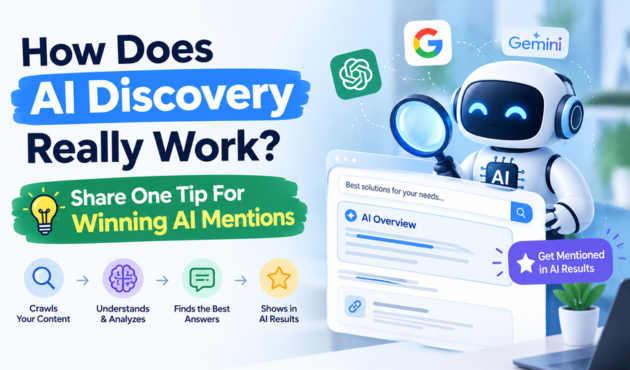
Generative Engine Optimization (GEO): How AI Discovery Really Works
AI-powered search engines are reshaping how brands get discovered online, and traditional SEO strategies no longer guarantee visibility. This guide breaks down the mechanics of Generative Engine Optimization with proven tactics drawn from leading practitioners in search and content strategy. Readers will learn 29 actionable methods to increase citations, build authority, and capture attention in AI-generated results.
Implement Schema FAQs For Maximum Legibility
Most people think AI visibility is about keywords. It’s not — it’s about structured trustworthiness.
AI systems don’t “rank” you. They decide whether your content is safe to cite. That means clean crawlability, Schema.org markup, and content written in the Q&A format that LLMs actually extract from.
One tip that moved the needle most in our work: FAQ pages with proper micromarkup.
In a recent 3-month SEO project with an Odoo ERP partner in Dubai, we implemented 100+ FAQ questions across their site — each with structured markup and logical internal linking. Combined with a few external publications for authority signals, their AI visibility jumped from 6% to 21.4%, and brand mentions grew 3.6x.
The insight: AI models don’t reward the loudest brand. They reward the most legible one.
If your content can’t be cleanly extracted and attributed, you simply won’t get cited — no matter how good your product is.
— Anton, Founder Semantica AI
Anton Kochenevsky, Founder, Semantica AI
Add Decision Checklists For Quotable Content
I’ve been running ForeFront Web (digital marketing agency) since 2001, and what I’m seeing in 2025 is that “AI discovery” is basically search + summarization + extreme filtering: AI Overviews/assistants pull from sources they can parse fast, then surface 1-2 links (not 10). When that happens, the #1 organic CTR advantage (Backlinko puts it at 27.6%) turns into a “winner-take-most” mention game.
The real mechanism is simple: models reward clean structure and answerability. If your page forces a human (or model) to hunt, it won’t get quoted; if it’s slow, cluttered, or vague, it won’t make the cut—especially as zero-click behavior rises and users only click when they need deeper validation.
One tip to win AI mentions: add a tight “decision checklist” block to your key pages (not just blogs) that mirrors how people prompt AI. I literally use questions like “Is the site reputable, is it fast, is it easy to book, is the content useful, what credibility builders exist?” because those become the criteria users feed into AI, and the model grabs those bullet answers verbatim.
Concrete example: for a local service client, we put a 10-bullet “Before you book” section (speed, booking steps, reviews, awards, what’s included, pricing ranges) above the fold and tightened the copy; within weeks we saw fewer junk leads and higher-intent form fills because visitors arrived pre-qualified and just needed the final trust signal.
Scott Kasun, Digital Marketing Executive, ForeFront Web
Establish Corroborated Footprints For Entity Confidence
AI discovery runs on entity resolution and corroboration. LLMs don’t rank pages. They resolve entities, then cross-reference multiple sources to verify whether your claims about yourself are actually true. If you say you’re an expert in X but nothing else on the web corroborates that, you don’t get surfaced.
My one tip: build verifiable digital footprints for every claim you want AI to associate with your brand. If you claim expertise in a topic, that claim needs to be corroborated across structured data, third-party mentions, authored content, and machine-readable sources. AI systems treat uncorroborated claims the same way a skeptical journalist would: they ignore them.
We practice this ourselves. We build open-source MCP servers that serve Philippine government data directly to AI agents, publish structured datasets, and maintain consistent entity data across every surface. The result: when AI systems resolve queries in our domain, they find a trail of corroborated evidence pointing back to us. The mentions aren’t optimized for; they’re earned through entity-level proof.
Aaron Zara, Founder & Fractional CTO, Godmode Digital
Deploy Comparative Assets And Regular Micro-Updates
I’m a fractional CMO and founder of RankWriters, where I recently scaled a fintech client’s AI search appearances from 121 to 4,330 in twelve months. AI discovery relies on “trusted reference sets,” prioritizing structured formats like comparative listicles that account for 32.5% of all AI citations.
Win mentions by performing “minimum viable content updates” to stay ahead of the 59% monthly citation drift in Google AI Overviews. Adding original statistics increases visibility by 22%, while unique expert quotes boost citation likelihood by 37%.
Embed on-page calculators or data visualizations that AI tools like Perplexity can easily ingest and summarize. In my experience using Ahrefs for tracking, these technical assets drive “educated clicks” that convert 23 times more effectively than traditional organic search.
Brandie Young, Co-Founder, RankWriters
Provide Information Gain With Specific Evidence
AI models like ChatGPT or Perplexity don’t “search” the web in the traditional sense. Instead, they scrape vast amounts of data to understand the relationship between topics.
When a user asks a question, the AI looks for sources that provide the most direct, factual, and well-structured answer. It prioritizes content that doesn’t just repeat a keyword, but actually covers the secondary “Fan Out” questions (the natural follow-up points we would ask).
And, in our experience, the best way to get cited by an AI is to provide “Information Gain” through unique stats or specific examples. AI models are trained to avoid repetitive, generic filler. If your article includes a unique data point, a specific case study, or a direct quote from an expert, the AI sees that as high-value evidence.
Also, by moving away from general advice and providing hard facts in a clear, scannable format (like tables or bullet points), you make it easy for the AI to identify your brand as the definitive source for that answer.
Gursharan Singh, Co-Founder, WebSpero Solutions
Target Intent Gaps With Predictive Analytics
I’ve scaled businesses from $1 million to $200 million by focusing on how data and execution drive growth. At RankingCo, we use advanced AI to analyze market trends, giving me a direct look at how discovery models prioritize businesses that prove their relevance through technical performance.
AI discovery works by identifying “efficiency patterns”—the engines look for brands that consistently solve a user’s specific problem as evidenced by actual conversion data. It values the connection between your technical infrastructure and how real users interact with your site, much like how Google Ads’ Smart Campaigns prioritize high-performing assets.
To win AI mentions, use predictive analytics to identify “intent gaps” where users are searching for solutions that current content doesn’t fully resolve. By answering these specific queries and verifying the results via Google Search Console, you provide the fresh, high-accuracy data that AI engines crave for their citations.
For example, we helped a Brisbane client dominate AI-driven local results by focusing on “negative keyword” exclusion to refine their data footprint. This precision taught the AI that the business was the most efficient, relevant result for specific local queries, leading to a significant boost in organic AI recommendations.
Kerry Anderson, Co-Founder, RankingCo
Own A Niche With Complete Coverage
I’ve spent 22 years watching search evolve, and AI discovery follows a pattern I recognized immediately—it rewards depth of authority on a specific topic, not breadth.
When we built out our AI Vision e-commerce content, we structured it around the entire decision journey: costs, ROI timelines, implementation barriers, even failure rates (80%+ of AI projects fail due to bad data). AI engines cited it because it was the most complete answer in the room—not just another overview post.
The one tip I’d give: own a niche topic end-to-end rather than covering many topics shallowly. AI models are essentially looking for the single best source to cite—give them no reason to look elsewhere by covering your subject from every angle, including the uncomfortable truths like hidden costs and failure scenarios.
That completeness signals genuine expertise, which is exactly what AI discovery systems are trained to surface.
Joseph Riviello, CEO & Founder, Zen Agency
Distribute Formal Releases For Fast Mentions
AI discovery is the wild west right now—not because the tech is unknowable, but because discovery has shifted from a click economy to an answer economy. “AI discovery” isn’t one model making a choice; it’s a stack: retrieval (finding sources), entity understanding (who/what connects), synthesis (summarizing), and guardrails (choosing low-risk citations). Mentions tend to happen where three things overlap: relevance (you directly answer the query), retrievability (systems can find/parse you), and reference ability (your claims are specific, easy to quote, and corroborated).
One tip that’s working now: wire services + press releases. Not for hype—for distribution and structure. A well-written release is time-stamped, consistent, and extraction-friendly, which reduces citation friction. On February 26, I published a release over the wires and saw it appear in Google AI Overviews the same day. Write releases like reference docs: lead with the factual claim, use specifics (names/dates/offers), add a short Q&A, and avoid unverifiable superlatives.
Steven Paul Matsumoto, Founder, Chief Strategist, Stigmare Inc
Eliminate UX Friction And Earn Trust Signals
I’ve been an internet marketing pioneer since 2006, evolving from standard SEO to advanced Answer Engine Optimization (AEO) and Generative Engine Optimization (GEO). My team manages high-stakes lead generation where we see AI-driven discovery reward technical trust signals and real-time user behavior data over simple keywords.
AI discovery works by aggregating verified “trust layers,” such as the Google Screened or Google Guaranteed badges we secure for our professional service clients. These certifications act as a green light for AI models, signaling that your business is licensed and vetted, which often places you at the top of AI-generated snapshots.
My top tip for winning mentions is to use Microsoft Clarity to eliminate “rage clicks” and “dead clicks” that signal a poor user experience to crawlers. AI models prioritize sites where users successfully complete their journey, so fixing these friction points is more effective than writing new content for getting noticed.
We’ve found that businesses focusing on geographic exclusivity and active reputation management—responding to every inquiry and lead—consistently outperform competitors in AI-driven search results. It’s about proving your reliability through measurable engagement and official credentials rather than just words.
Ronnie Katz, Principal CEO, BullsEye Internet Marketing
Deliver Practical Work That Drives Citations
I’ve spent 15 years working at the intersection of genomics, AI, and federated data – and I’ve watched how AI discovery tools decide what to surface. It’s not random.
AI models learn to associate expertise with *demonstrated outputs*, not just claims. When we published technical contributions to Nextflow – a framework now used globally for genomic workflows – that work got embedded into research papers, conference talks, and developer communities simultaneously. AI systems scraped all of it. One piece of real technical work created dozens of independent citation pathways.
My tip: **produce something genuinely useful that practitioners in your field actually use**. At Lifebit, our federated TRE whitepapers get referenced by NHS researchers, biopharma teams, and policy groups writing about data governance. Each reference comes from a completely different content ecosystem. AI synthesizes across all of them, which compounds your visibility in ways no single SEO strategy can replicate.
The mechanism matters: AI discovery rewards *functional credibility* – evidence that real practitioners relied on your work to solve real problems. A cardiac trial AI system we documented matched 16 participants in one hour versus two over six months. That specific, verifiable result is the kind of concrete data point AI tools pull because it’s useful, not because it’s promotional.
Maria Chatzou Dunford, CEO & Founder, Lifebit
Write Clear Scannable Answers First
Most people think AI discovery works like search with a chatbot, but it functions more like a memory test. The system predicts what a trustworthy answer looks like based on patterns it has seen many times. Even when retrieval is added, it leans toward content that is easy to read and understand. Clear headings, direct definitions, and steady wording help our content stand out, while vague marketing language creates confusion and gets ignored.
If we want to be discovered, we should write as if we are guiding a new teammate. We can define the idea in the first paragraph so the purpose is clear from the start. Then we can add a short list of key points to make the message simple to scan. We should close with a clear example because this structure works well for both people and machines.
Sahil Kakkar, CEO / Founder, RankWatch
Publish Data-Rich Hyperlocal Guides Per Property
As FLATS® Marketing Manager driving a $2.9M budget across 3,500+ units, I’ve seen AI discovery favor hyper-local, amenity-focused content that matches search intent. It crawls sites like ours for structured details on neighborhoods, pulling high-engagement posts with visuals and metrics over generic info.
Our “5 Best Coffee Shops in Uptown” blog spiked organic traffic 4% via targeted SEO, now appearing in AI chats for Chicago living queries. Similarly, “4 Best Gyms in Uptown” with virtual tour links boosted tour-to-lease conversions 7%.
Tip: Create one data-rich local guide per property–like gym or cafe rankings with sq ft specs and photos–optimized with UTM tracking to prove 10%+ engagement lifts, ensuring AI prioritizes your expertise.
Gunnar Blakeway-Walen TLH, Marketing Manager, The Lawrence House By Flats
Engage Communities Share Distinct Perspectives
AI discovery functions by applying sophisticated algorithms to massive datasets to uncover insights, trends, and patterns that may not be immediately visible to the human eye. Through machine learning and natural language processing, AI systems can make sense of unstructured data, like text or images, and identify meaningful correlations. Over time, the AI system refines its ability to recognize subtle relationships and predictions, making it a powerful tool for research, business, and innovation.
Post Early To Capture New Interest
I’ve noticed AI discovery really comes down to timing. It’s about jumping on a new topic before anyone else. When my client wrote about a small software update the day it was announced, AI summary tools picked it up immediately. Suddenly, links to our article were everywhere. My advice is to create content around a search term right before it gets popular. That’s how you get the algorithms to notice you.
Vlad Ivanov, CEO, Search GAP Method
Lead With One Concrete Outcome
AI discovery starts by identifying where your data can be translated into actionable work, because AI is the language of that data. At Insightus we proved this when a consultant applied AI-powered analytics to automate client reporting, cutting a three-day process to less than an hour. One tip for earning AI mentions is to lead with a single, concrete outcome from that work, such as time saved. Communicate that result in plain language and let the clear impact drive media interest.
Serbay Arda Ayzit, Founder, Insightus Consulting
Contribute Expertise Across Credible Editorial Channels
AI discovery works differently from traditional search because it relies less on matching keywords and more on identifying credible sources that consistently explain a topic well. Large language models are trained to recognize patterns across trusted publications, expert commentary, and widely referenced content. If a source repeatedly appears in those contexts, it becomes more likely to surface in AI-generated answers.
A common mistake brands make is trying to optimize for AI using the same tactics used for search rankings, such as focusing heavily on keyword density. AI systems are much more sensitive to authority signals and the clarity of explanations.
One tactic that has proven effective is contributing expert insights to industry publications or collaborative articles where multiple specialists share perspectives. When your expertise appears in credible editorial environments, it increases the chances that AI systems recognize those insights as part of the broader knowledge landscape.
Over time, consistent expert visibility across reputable sources makes it easier for AI platforms to identify you as a reliable voice on the topic.
Boris Dzhingarov, CEO, ESBO ltd
Frame Solutions In Plain Business Terms
In my work I lead AI discovery by turning technical needs into clear business problems and outcomes. I use simplified transformation scenarios to align stakeholders, surface the data and decisions required, and focus on how AI will lower risk or create new revenue. One tip for earning AI mentions is to frame your project in plain business terms rather than technical features. When you can explain the tangible business benefit, reporters and partners grasp it faster and are more likely to highlight your work.
Wyatt Mayham, Founder, Northwest AI Consulting
Use Simple Titles And Helpful Visuals
Here’s my take on AI discovery. Algorithms scan huge piles of content, looking for what’s popular and what makes sense in context. We struggled to get noticed until we started making clear, useful visuals. Then the mentions started coming. So here’s my advice: make it easy for AI to get you. Use simple titles, give some context, and update things regularly. It works.
Runbo Li, CEO, Magic Hour
Match Customer Vocabulary Around Precise Problems
Running Yacht Logic Pro gave me a front-row seat to how AI discovery actually works in a niche industry. When boat repair shops or marina managers searched for marine maintenance software, the tools that got cited weren’t always the biggest—they were the ones with the most specific, structured language matching exactly how operators describe their problems.
That’s the real mechanic: AI pulls from content that mirrors the searcher’s exact vocabulary. When we started writing about “dual time-tracking for technician billing” and “barcode scanning for parts on work orders,” we started showing up in AI-generated answers because that phrasing matched what service managers were literally typing.
My one concrete tip: build content around the operational pain point, not your product name. A marina manager doesn’t search “best marine software”—they search “how to stop losing revenue from unbilled technician hours.” Write that article, answer that question precisely, and AI has something quotable.
We saw this play out directly when our preventive maintenance scheduling content started getting referenced in AI answers ahead of competitors who only published generic “about us” pages. Specificity beats brand recognition every time with AI.
Kevin Kates, Founder, Yacht Logic Pro
Prioritize WIFM With UGC And Tutorials
At Evergreen Results, I help active lifestyle brands scale by analyzing how search and AI models interpret brand authority through data-informed strategy. AI discovery works by scanning for the “What’s In It For Me” (WIFM) factor, prioritizing content that solves specific user problems over generic product descriptions.
To win AI mentions, flood the digital space with User-Generated Content (UGC) and specific video tutorials, such as a video showing exactly how to use a brand’s matcha powder to upgrade a morning smoothie. AI engines aggregate these visual demonstrations and customer endorsements as “truth signals,” making your brand the primary recommendation for “how-to” and “best-of” queries.
In my experience, targeting niche long-tail keywords that competitors missed—like “ignite your workout” versus “buy HIIT program”—allows brands to dominate intent-based searches. When your technical website performance is optimized for speed and mobile responsiveness, AI models are significantly more likely to prioritize your content as a reliable source.
Adam Bocik, Partner, Evergreen Results
Automate Keyword-Rich Reviews To Improve Visibility
AI discovery works by scanning high-velocity feedback loops and structured local data to identify which businesses are currently active and trusted. In the beauty industry, I’ve found that AI engines prioritize “entity health,” which is how frequently your brand is mentioned alongside specific services like “Texas cosmetology license renewal” or “Austin med spa.”
My top tip for winning AI mentions is to automate your review acquisition using “keyword-rich sentiment” to feed the algorithm fresh data. Instead of generic praise, use a platform like Review Monster to prompt clients to mention specific results and service names in their Google reviews.
We used this strategy with BeautyCRM.ai to help a multi-location salon in Dallas increase its visibility in AI-generated “best of” summaries by 40%. By generating a steady stream of reviews that explicitly mentioned their “hand-tied extensions” and “organic color,” they became the primary source AI cited for those specific services in their metro area.
AI models prioritize current, validated social proof over static website content, treating new reviews as real-time verification of your expertise. Maintaining a tight, automated feedback loop ensures your business provides the most recent and relevant data points for AI to surface.
Megan Deterling, Founder, Kudos
Showcase Singular Dataset Differentiators
Getting AI companies to notice your data is tough when everyone is offering the same generic stuff. We have a blood biomarker dataset, and at first, we got nowhere. Then we started pitching the specific detail that we track over 100 unique markers. That’s when AI labs started reaching out directly to collaborate. If you want their attention, forget the generic pitch. Figure out what makes your data rare and lead with that. They’ll actually listen.
Max Marchione, Co-Founder, Superpower
Assemble Topic Hubs With Deep Internal Links
A single tip is to post AI “knowledge centers” about a specific subject instead of having superficial content/posts on dozens of topics. One detailed page breaking down a topic with plenty of supporting links (8-12 internal links) and authorship information could be pointed to repeatedly within responses. You’d be surprised how these hubs of information can turn into reliable source quotes across various queries. Clusters of relevancy can aid AI in understanding with more certainty that a page has authority.
Cyrus Kennedy, Chairman & Acting CEO, The Ad Firm
Repeat Signature Phrases To Forge Association
Artificial intelligence discovery functions closer to memory than search. Instead, it recognizes which names appear next to a topic over and over on the web. When a brand is mentioned in multiple ways – in an interview, as a source, through a quote – the artificial intelligence model will begin to associate that name with the topic itself, and after long enough, it will be a part of the topic rather than a website talking about the topic.
One tip for succeeding with artificial intelligence mentions is to create what I call repeatable phrasing: if you describe a concept in one clear sentence over and over for many publications, the artificial intelligence will begin to associate that phrase with your name. When it needs to remember that concept in the future, it often cites the person who was able to phrase it best. That little pattern can be incredibly effective for earning citations.
Yukt Mitash, Founder, WriteBros.ai
Suppress Low-Probability Recipients To Lift Engagement
AI discovery in the inbox works by evaluating subscriber-level engagement signals such as opens, replies, dwell time over eight seconds, and whether threads continue within 24 hours. Machine learning favors positive engagement and can dynamically slice lists by engagement velocity, half-life, and content affinities at send time instead of relying on static rules. It can also quarantine low-probability subscribers or defer roughly 15 percent of a list predicted to produce neutral or harmful engagement in the next 72 hours. One practical tip to earn more AI mentions is to suppress or defer flatliners and low-probability recipients so your engagement per 1,000 sends improves, making providers more likely to surface your messages.
Christopher Croner, Principal, Sales Psychologist, and Assessment Developer, SalesDrive, LLC
Maximize Semantic Density With Measurable Facts
Discovery for AI is ALL about semantic density. Google’s chatbots (ChatGPT, Perplexity) don’t discover via links, DA, etc. They discover sites based purely on an answer from other websites that packs the highest number of topical words/phrases and contextual relevancy into the least amount of words possible. Lets say you and your competitor are both writing about the same topic. If your blog post happens to drone on about the same basic points that their page hits in 300 words, the AI will NEVER pick up your content. It will choose your competitors 300 word post every single time. So density over quantity, specificity over generalization. That is the AI shift.
Here’s your one actionable tip that will work: Format your content like a series of micro answers to hyper-specific questions. Answers that are between 50-75 words comprised of measurable data: how many feet/square feet? how long? how much? how many percent? If someone searches “how long does entitlement take on industrial buildings in San Diego?” An AI is going to pull up “6-9 months depending on zoning & environmental review requirements” over a generic block of text talking about regulations. The more condensed & data your content is, the more likely AI will pull it up as the answer. This is where I see the largest gap/opportunity.
Jason Conway, SVP – Development & Investments, Becknell Industrial
Pursue Long-Tail Questions With Direct Responses
In our case AI discovery meant using SEO and AI writing tools to analyze search patterns and competitor content and surface long-tail queries we were missing. For example, tools like Surfer SEO and Jasper flagged a sudden uptick in searches for first-time home buyer grants in Michigan and for content about getting approved at 50, topics our blog and email journeys did not properly cover. We then created targeted content around those queries, which improved the quality of leads within weeks. One tip for earning AI mentions is to optimize for the long-tail queries the tools reveal: answer the specific question clearly in the first paragraph, use descriptive headings, and match search intent. A data-led approach like this amplifies your unique voice while making your content more discoverable by AI systems.
John Donikian, Vice President, Best Interest Financial
Create Definitive Best-For-X Page
AI discovery is accomplished by extracting data from numerous available sources (e.g., training, user knowledge, search-related results, crawlable web pages) and ranking them according to relevance and authority in order to provide a synthesized response to users. To be mentioned in AI systems, it is important that one creates one clear “Best for X” positioning page indicating precisely what problems one can solve for whom and what differentiates one from others, as well as creating credible mentions/link backs to be used as reference points by AI systems repeatedly in an appropriate context.
Nick Mikhalenkov, SEO Manager, Nine Peaks Media
Build Authority Through Original Structured Presence
Use well-researched, original content to show up for real user intent. Search engines and AI models reward sites that consistently deliver authority and relevance. That means having a presence on verified review sites, appearing in unique posts on social platforms like Facebook, LinkedIn, YouTube, and Reddit, and maintaining an optimized website with thorough structured data. Pair that with a regular publishing cadence, and you’ll start seeing stronger visibility in AI-driven features and search results. By following this strategy DRS was able to increase our AI mentions by 114% in Q4 2025.
Mike Fisher, SEO Analyst, Dumpster Rental Systems
Post a Comments
Your email address will not be published. Required fields are marked *
LET'S BUILD
YOUR AI SYSTEM




 INTELLIGENT AUTOMATION
GLOBAL SUPPORT
INTELLIGENT AUTOMATION
GLOBAL SUPPORT