
WE ARE AVAILABLE FOR DECEMBER PROJECTS


AI Personalized Search Intent: 3 Ways It Impacts Your Long-Tail SEO Strategy



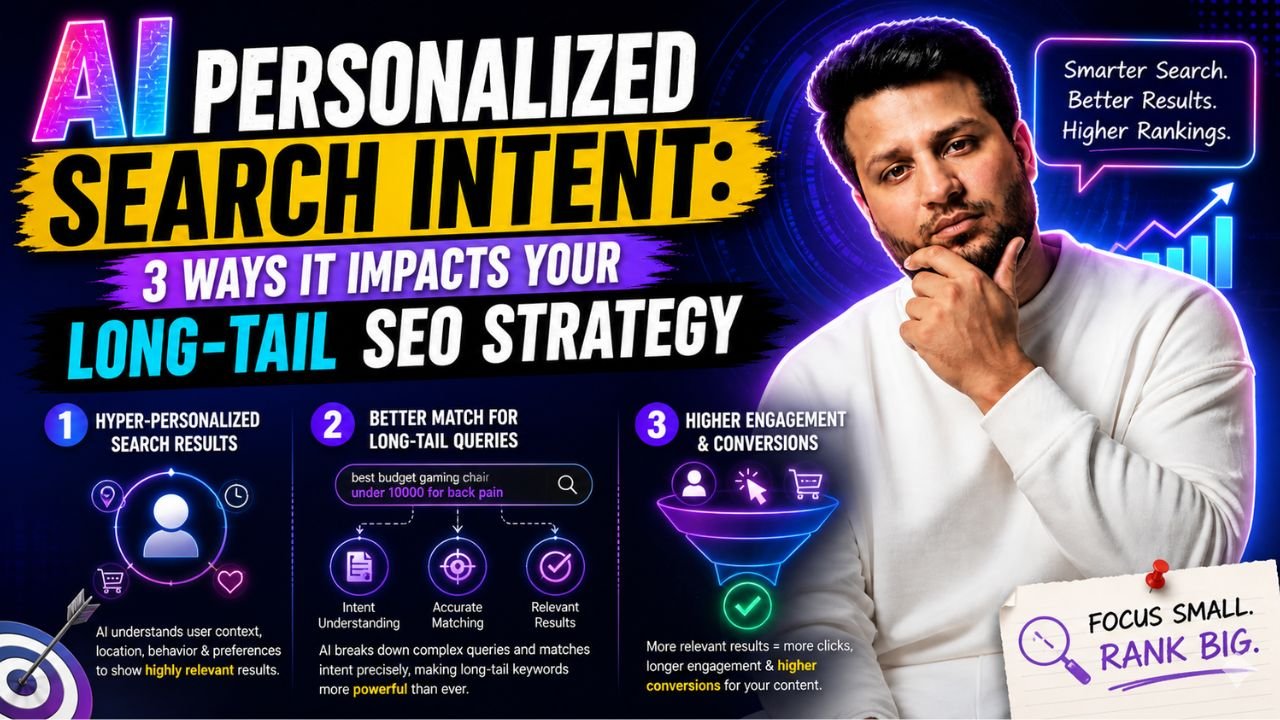
AI-Driven Search Intent Personalization: What It Means for Long-Tail SEO Strategy
Search engines now interpret user intent with unprecedented accuracy, fundamentally changing how websites compete for long-tail traffic. This shift requires SEO professionals to rethink traditional keyword strategies and focus on solving specific user problems rather than chasing search volume. Industry experts share practical approaches for adapting content strategies to match AI-powered search behavior and maintaining visibility in an intent-driven ecosystem.
- Topical Depth Beats Unpredictable Long-Tail Searches
- Own Specific Questions That Prospects Ask
- Strengthen Presence Across Referenced Platforms
Topical Depth Beats Unpredictable Long-Tail Searches
The era of predictable search volume for long-tail queries is dying, but topical authority still captures that traffic even when personalization varies by user.
Here’s what I’m seeing in the data: traditional long-tail keyword targeting (find exact phrase, optimize for it, track rankings) is becoming unreliable. The same query can trigger completely different results based on user history, location, device, and conversational context in AI search.
Example: “best SEO agency for small business” might show completely different results for someone who previously searched local services versus someone researching enterprise solutions. AI personalizes based on inferred intent from past behavior.
But here’s the critical insight: while the specific results personalize, AI systems still prioritize authoritative sources within that personalization. If you’re recognized as a topical authority, you show up across personalized variants because the AI trusts you regardless of individual user context.
The strategy shift: stop optimizing for individual long-tail keywords. Start building comprehensive topical authority that captures the entire semantic cluster.
Real implementation: instead of creating separate pages for “Denver SEO for dentists,” “Denver SEO for lawyers,” “Denver SEO for contractors,” we create comprehensive authority content about local service business SEO that naturally captures all those variants. Then we build E-E-A-T signals proving we’re the expert for that entire topic.
Results: one comprehensive guide ranks for 47 different long-tail variations we never specifically targeted. Why? Because we demonstrated deep topical expertise, so AI systems surface us regardless of how users personalize their query.
The mistake agencies make: chasing every long-tail variant with separate optimized pages. That worked in 2015. In 2026, it’s wasted effort because personalization fragments those queries unpredictably.
What works: create pillar content demonstrating genuine expertise on core topics. Build authority through Featured.com publications, speaking, case studies. Let AI systems recognize you as the credible source, then they’ll surface you across personalized variants automatically.
Can you “capture” personalized traffic? Yes, but not through traditional keyword targeting. Through authority building that makes you the default citation regardless of personalization.
Chris Raulf, International AI and SEO Expert | Founder & Chief Visionary Officer, Boulder SEO Marketing
Own Specific Questions That Prospects Ask
Predictable search volume isn’t over — it’s just less useful as the primary optimization signal. What we’re seeing in legal SEO is that AI personalization actually rewards the same fundamentals that always separated good content from forgettable content: specificity, genuine expertise, and intent precision.
Here’s what that looks like practically. A query like “car accident lawyer near me” will personalize heavily based on location signals and search history. But “what happens if I was partially at fault in a car accident in Texas” is specific enough that personalization has less room to diverge. The user who types that is in a defined mental state. They’re scared, they want a clear answer, and they’re probably comparing a few firms. The content that wins for that query — regardless of which personalized result set surfaces it — is the content that answers the actual question with legal clarity and then makes it obvious how to take the next step.
We’ve shifted our keyword strategy accordingly. Rather than building pages around head terms with high volume and heavy personalization variance, we now build pages around the specific questions attorneys tell us prospects ask during intake calls. These are conversational, long-tail, and intent-dense. “Do I have to pay back my medical bills if I win a settlement?” or “Can I sue if the at-fault driver was uninsured?” These queries don’t get a lot of tools-based volume data, but they convert at a rate head terms can’t match.
The practical answer to “how do you capture personalized traffic” is: stop trying to capture volume and start trying to own the answer to a specific question better than anyone else. That strategy works regardless of what the personalization layer does with distribution, because you only need to be found by the right person once.
Abram Ninoyan, Founder & Senior Performance Marketer, GavelGrow, Gavel Grow Inc
Strengthen Presence Across Referenced Platforms
Search is getting more personalized, and for longer, more specific searches, Google is pulling from all over, like directories, review sites, not just your Google Business Profile. That’s why relying on just one platform doesn’t work as well anymore. From my experience owning a service business, I now track which platforms AI references and ensure we have strong, complete listings on those sites with clear service details, updated photos, and good reviews. Being strong in the map pack still matters, but it must be paired with consistent presence across the other sources AI pulls from. You can still capture personalized long-tail traffic by making sure your business shows up and is well-represented on the platforms that feed AI answers.
Aaron Traub, New Orleans Seo Specialist + Web Designer, Geaux SEO
Post a Comments
Your email address will not be published. Required fields are marked *
LET'S BUILD
YOUR AI SYSTEM




 INTELLIGENT AUTOMATION
GLOBAL SUPPORT
INTELLIGENT AUTOMATION
GLOBAL SUPPORT